Digital messaging to improve college enrollment and success

2021

We investigate the efficacy of text messaging campaigns to support students with key steps in the college search, application, selection and transition process with concurrent cluster randomized control trials. Collaborating with national non-profit organizations, we implemented text-message based outreach to students in the high school graduating class of 2016 in over 700 high schools that primarily serve low-income students. Collaborating with several Texas school districts, we implemented a school-based version of the intervention. In contrast to the national version which produced null and negative effects, the school-based intervention yielded positive and significant impacts on several college-going steps but still only yielded significant impacts on college enrollment and second-year persistence for certain subgroups.

Suggested Citation:

Suggested citation

Avery, C., Castleman, B. L., Hurwitz, M., Long, B. T., & Page, L. C. (2021). Digital messaging to improve college enrollment and success. Economics of Education Review, 84, 102170. https://doi.org/10.1016/j.econedurev.2021.102170

Share

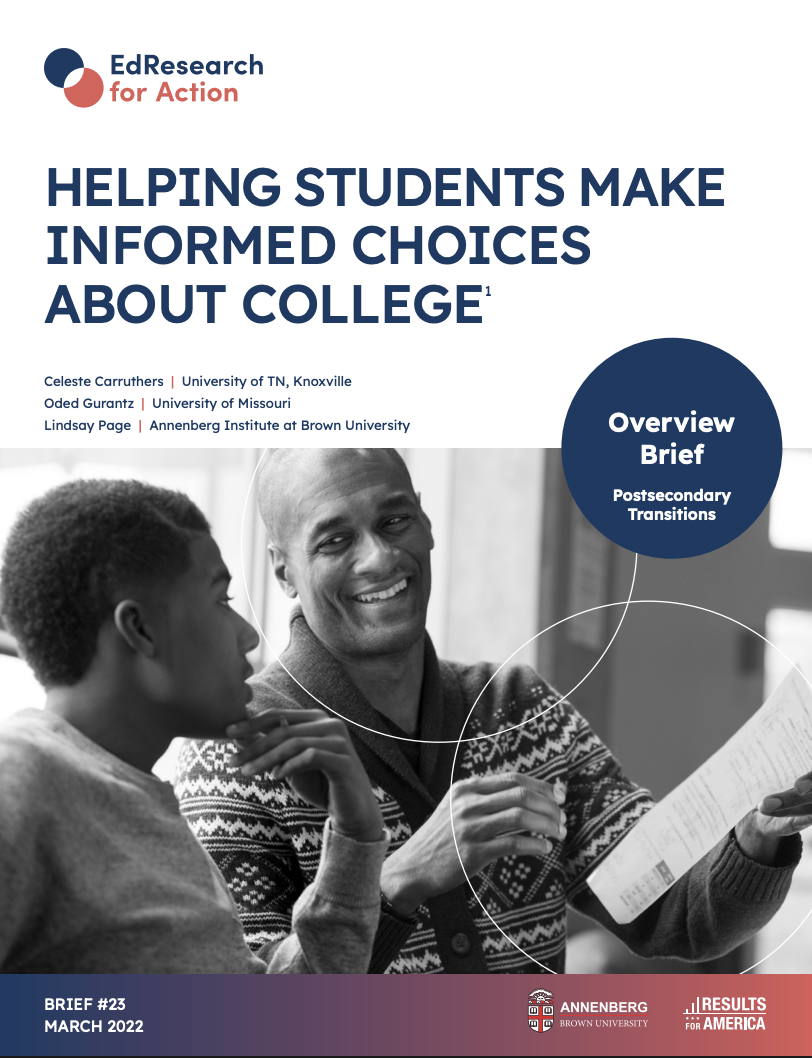
Helping Students Make Informed Choices About College

2022

While a college education typically results in higher earnings and non-monetary benefits, many students—especially those from disadvantaged backgrounds—struggle with the application process and summer transitions. This brief examines the challenges and strategies associated with college enrollment, particularly in the wake of the COVID-19 pandemic. Providing students with greater access to college counselors, structured time for application tasks, and guidance on where to apply can significantly improve enrollment rates. Targeted outreach, progress tracking, and summer support further help students stay on track. 

The EdResearch for Action Overview Series summarizes the research on key topics to provide K-12 education decision makers and advocates with an evidence base to ground discussions about how to best serve students. Authors – leading experts from across the field of education research – are charged with highlighting key findings from research that provide concrete, strategic insight on persistent challenges sourced from district and state leaders.

Suggested Citation:

Suggested citation

Carruthers, C., Gurantz, O., & Page, L. C. (2022). Helping students make informed choices about college (EdResearch for Action Overview Series Brief No. 23). Annenberg Institute at Brown University. https://edresearchforaction.org/research-briefs/helping-students-make-informed-choices-about-college/

Share

◆
Publication Type

Chapter 5 - Addressing nonfinancial barriers to college access and success: Evidence and policy implications

2023

Nonfinancial barriers to college are an important possible explanation for socioeconomic, racial, gender, and other gaps in college access and success. A sizeable economic literature documents policy efforts to understand and address these barriers. We review this literature on nonfinancial interventions for improving college access and success ranging from discrete and narrowly defined efforts to comprehensive and multifaceted programs and systemic-level solutions.

Suggested Citation:

Suggested citation

Dynarski, S., Nurshatayeva, A., Page, L. C., & Scott-Clayton, J. (2023). Addressing nonfinancial barriers to college access and success: Evidence and policy implications. In E. A. Hanushek, S. Machin, & L. Woessmann (Eds.), Handbook of the economics of education (Vol. 6, pp. 319–403). Elsevier. https://doi.org/10.1016/bs.hesedu.2022.11.002

Share

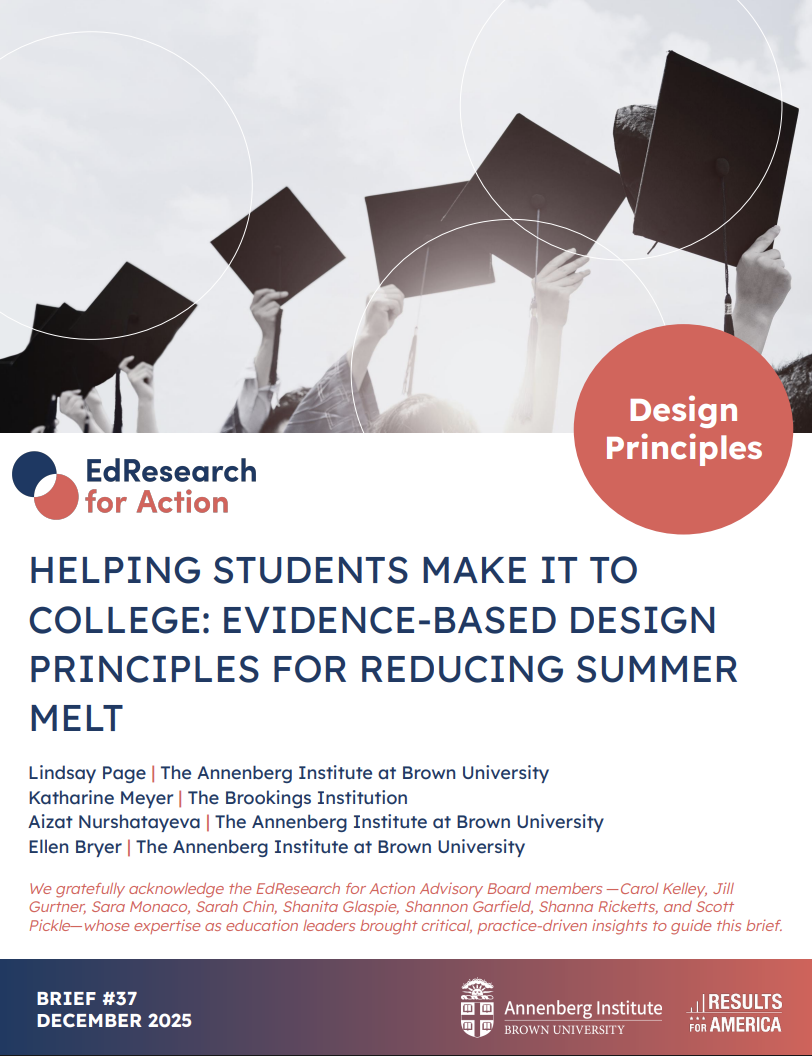
Helping Students Make It to College: Evidence-Based Design Principles for Reducing Summer Melt

2025

In this research brief, we examine the phenomenon of summer melt—when college-intending high school graduates fail to matriculate—and outline evidence-based strategies schools and districts can use to help students successfully transition to college. Drawing on rigorous studies of real-world programs, we identify four effective models to reduce summer melt: behavioral nudges and messaging, counselor-led summer outreach, peer or near-peer mentoring, and summer bridge programs. Across these models, strong evidence shows that timely, personalized communication, support with financial aid and complex enrollment tasks, trusted relationships, and availability of summer advising can meaningfully increase college enrollment and persistence, particularly for low-income and first-generation students. We also discuss the systemic conditions that enable these efforts and clarify how districts can target resources to students at greatest risk. Overall, this brief aims to equip K–12 leaders with clear, actionable guidance to strengthen postsecondary transitions and ensure more students make it to campus in the fall.

Suggested Citation:

Suggested citation

Page, L. C., Meyer, K., Nurshatayeva, A., & Bryer, E. (2025). Helping students make it to college: Evidence-based design principles for reducing summer melt (EdResearch for Action Brief No. 37). Annenberg Institute at Brown University. https://edresearchforaction.org/research-briefs/helping-students-make-it-to-college-evidence-based-design-principles-for-reducing-summer-melt/

Share

The View from the Top: The Relationship Between Parental Education and Graduate Enrollment

2025

Given the dramatic risks and rewards to different graduate pathways, it is imperative to understand disparities in access to the highest levels of education. This paper responds to a tension between the traditional understanding that parents’ education ceases to influence children’s educational trajectories after college and the more recent reemergence of family background as a predictor of children’s socioeconomic attainment. This paper asks two questions: to what extent is parental educational background associated with (1) graduate enrollment overall and (2) enrollment into particular credentials (e.g. master’s, professional, and research doctoral degrees)? Drawing on data from the 2008–18 Baccalaureate and Beyond study, findings reveal that parental educational background, especially parental graduate degrees, are associated with enrollment into graduate school. By using two measures of parental education and disaggregating the outcome into different credentials, this paper shows that highly educated parents are associated with a greater advantage for doctoral enrollment than for master’s enrollment. Due to the close ties between doctoral credentials and elite, high-paying occupations, this study has implications for inequality in higher education and economic inequality more broadly.

Suggested Citation:

Suggested citation

Bryer, E. (2026). The View from the Top: The Relationship Between Parental Education and Graduate Enrollment. The Journal of Higher Education, 97(1), 119–147. https://doi.org/10.1080/00221546.2025.2450203

Share

Senior Research Associate (Early Literacy Policy)

About Brown

Brown University is a leading research university distinct for its student-centered learning and deep sense of purpose. Our students, faculty and staff are driven by the idea that their work will have an impact in the world.

Brown University offers a flexible work/life balance; summer hours, winter break and a comprehensive Benefits package including time off, annual paid holidays; benefits offerings including health, dental, vision, tuition assistance, retirement, wellness, employee discounts and more.  To learn about Brown University’s benefits, visit the University Human Resources web page for further information.

About the Annenberg Institute

The Annenberg Institute is Brown University’s education research institute. Our vibrant community includes Brown University faculty, postdoctoral research associates, staff, students, and multiple partners in Rhode Island and across the US. We partner with education leaders and global scholars to connect people, evidence, and practices to build toward a more effective and equitable education system that enables all students to thrive academically and in other ways. Our knowledge initiatives catalyze conversations across the research landscape, synthesizing what we know and mobilizing practitioners, policymakers, and researchers toward collaborative impact.

About the Opportunity

The Senior Research Associate will support a large-scale evaluation of the Massachusetts Literacy Launch Initiative, a statewide effort to improve literacy instruction from pre-K to grade 3. The incumbent will join a large team supporting this evaluation to help explore the implementation and impact of several state early literacy policies on teacher and student outcomes.  The incumbent will help develop and lead key research analysis projects as part of the evaluation.

The incumbent will be part of the Annenberg Institute’s Research Partnership for Professional Learning (RPPL) research team, led by Annenberg faculty John Papay and Nathaniel Schwartz. RPPL is a partnership that brings together professional learning (PL) organizations, district and state education systems, and researchers from the Annenberg Institute to strengthen how the field learns about and improves teacher professional learning. RPPL’s central goal is to rethink how we learn about teacher PL, shifting from studies that explore whether a specific program works to a broader learning agenda designed to identify how PL design features and the enabling conditions of PL improve teachers’ instructional practice and, as a result, students’ classroom experiences, well-being, and academic growth. RPPL focuses on supporting the learning of teachers who work with students from historically marginalized groups.

Responsibilities:

Reporting directly to the Principal Investigators, the Senior Research Associate drives all aspects of project planning for multiple research projects for this research team in a dynamic, layered team setting. The position takes a lead role in designing studies, leads data collection and analysis efforts, develops project models, engages practitioners and PL organizations as partners in research work, and writes academic papers, reports, presentations, and grant reports.

The incumbent will need to have a strong understanding of early literacy policy and practice and extensive expertise in quantitative and/or qualitative research methods. We are particularly interested in applicants with demonstrated experience using research to inform policy and practice.

Qualifications:

Education and Experience

  • Master’s degree in related field (PhD or EdD preferred) with 5-7 years of research experience or the equivalent combination of education and experience.

  • Ability to work independently or as a member of a team

  • Experience working on large-scale research studies

  • A strong quantitative background.

  • Strong background in education research.

Competencies:

  • Strong analytical and writing skills.

  • Training and expertise in utilizing quantitative research methods, including experience working with complex data sets.

  • Strong interpersonal and communication skills.

  • Strong ability to explain methods to research staff and provide guidance on models and interpretation of output.

  • Experience reviewing code and ensuring data best practices are being followed by the research team.

  • Experience distilling and translating substantive takeaways from analyses to policy/practitioner audience.

Additional Information:

This position is 100% grant funded and is for one year with the possibility of renewal, based on satisfactory work performance and dependent upon funding.

Please include a resume as one attached .pdf document, 2 writing samples as one attached .pdf document, and the cover letter, transcript, and letters of recommendation or names of references (3) as another single .pdf document (for a total of three attachments).

Background and education check required.

Research Scientist (Early Literacy Policy)

About Brown

Brown University is a leading research university distinct for its student-centered learning and deep sense of purpose. Our students, faculty and staff are driven by the idea that their work will have an impact in the world.

Brown University offers a flexible work/life balance; summer hours, winter break and a comprehensive Benefits package including time off, annual paid holidays; benefits offerings including health, dental, vision, tuition assistance, retirement, wellness, employee discounts and more.  To learn about Brown University’s benefits, visit the University Human Resources web page for further information.

About the Annenberg Institute

The Annenberg Institute is Brown University’s education research institute. Our vibrant community includes Brown University faculty, postdoctoral research associates, staff, students, and multiple partners in Rhode Island and across the US. We partner with education leaders and global scholars to connect people, evidence, and practices to build toward a more effective and equitable education system that enables all students to thrive academically and in other ways. Our knowledge initiatives catalyze conversations across the research landscape, synthesizing what we know and mobilizing practitioners, policymakers, and researchers toward collaborative impact.

About the Opportunity

The Research Scientist will support a large-scale evaluation of the Massachusetts Literacy Launch Initiative, a statewide effort to improve literacy instruction from pre-K to grade 3. The incumbent will join a large team supporting this evaluation to help explore the implementation and impact of several state early literacy policies on teacher and student outcomes.  The incumbent will help develop and lead key research analysis projects as part of the evaluation.

The incumbent will be part of the Annenberg Institute’s Research Partnership for Professional Learning (RPPL) research team, led by Annenberg faculty John Papay and Nathaniel Schwartz. RPPL is a partnership that brings together professional learning (PL) organizations, district and state education systems, and researchers from the Annenberg Institute to strengthen how the field learns about and improves teacher professional learning . RPPL’s central goal is to rethink how we learn about teacher PL, shifting from studies that explore whether a specific program works to a broader learning agenda designed to identify how PL design features and the enabling conditions of PL improve teachers’ instructional practice and, as a result, students’ classroom experiences, well-being, and academic growth. RPPL focuses on supporting the learning of teachers who work with students from historically marginalized groups.

Reporting directly to the Principal Investigators, the Research Scientist drives all aspects of project planning for multiple research projects for this research team in a dynamic, layered team setting. The position takes a lead role in designing studies, leads data collection and analysis efforts, develops project models, engages practitioners and PL organizations as partners in research work, and writes academic papers, reports, presentations, and grant reports.

The incumbent will need to have a strong understanding of early literacy policy and practice and extensive expertise in quantitative and/or qualitative research methods. We are particularly interested in applicants with demonstrated experience using research to inform policy and practice.

We welcome earlier career scholars to apply instead to a related Senior Research Associate role, for which we are also hiring.

The Annenberg Institute is Brown University’s education research institute. Our vibrant community includes Brown University faculty, postdoctoral research associates, staff, students, and multiple partners in Rhode Island and across the US. We partner with education leaders and scholars to connect people, evidence, and practices to build toward a more effective and equitable education system that enables all students to thrive academically and in other ways. Our knowledge initiatives catalyze conversations across the research landscape, synthesizing what we know and mobilizing practitioners, policymakers, and researchers toward collaborative impact.

This position is 100% grant funded and is for one year with the possibility of renewal, based on satisfactory work performance and dependent upon funding.

For this position, Brown does not sponsor the H-1B visa classification for scholars who need immigration sponsorship in order to enter the U.S. and commence lawful employment under the terms of their appointment.


Qualifications

  • An earned doctorate in Education, Public Policy, Economics, Sociology, Political Science or other affiliated fields is required by the position start date.
  • Ability to work independently or as a member of a team
  • Experience working on large-scale research studies
  • Strong background in education research.
  • Candidates will be assessed based on research output and post-degree experience. 

Application Instructions

Applicants should submit a cover letter, CV, two writing samples and contact information for three references. 

Candidates should address in their cover letter how they would contribute to the research and/or teacher missions of our diverse and inclusive university community. 

Doctoral Seed Funding

About Brown

Brown University is a leading research university distinct for its student-centered learning and deep sense of purpose. Our students, faculty and staff are driven by the idea that their work will have an impact in the world.

Brown University offers a flexible work/life balance; summer hours, winter break and a comprehensive Benefits package including time off, annual paid holidays; benefits offerings including health, dental, vision, tuition assistance, retirement, wellness, employee discounts and more.  To learn about Brown University’s benefits, visit the University Human Resources web page for further information.

About the Annenberg Institute

The Annenberg Institute is Brown University’s education research institute. Our vibrant community includes Brown University faculty, postdoctoral research associates, staff, students, and multiple partners in Rhode Island and across the US. We partner with education leaders and global scholars to connect people, evidence, and practices to build toward a more effective and equitable education system that enables all students to thrive academically and in other ways. Our knowledge initiatives catalyze conversations across the research landscape, synthesizing what we know and mobilizing practitioners, policymakers, and researchers toward collaborative impact.

About the Opportunity

Annenberg provides small grants to doctoral students from across the University whose work centrally engages with education (writ large). Grants are typically up to $5,000 but can be larger in exceptional cases. Seed funding can support research, partnership, or dissemination efforts (e.g., conduct fieldwork, collect or purchase data, conduct exploratory research, travel for partnership work, summer funding, etc.). The goal is to seed and support empirical research in education.

Applications will be accepted at three deadlines: April 1, September 1, and January 1. Preference will be given to existing Annenberg Doctoral Affiliates who engage actively in the Institute and to projects most directly tied to the Institute’s goals.

 To apply, please submit an application of no more than two pages describing:

  • Project Title
  • Short Title (10 words or fewer)
  • A brief description of the project (what work will the funding advance?)
  • A clear rationale for the award (why do you need these funds?)
  • A description of the product(s) that will result (what are the specific products/outcomes?)
  • A timeline, budget and justification (how will the funding be used?)

Send applications to annenberg@brown.edu with “Annenberg Doctoral Student Seed Funding” in the subject line. 

Recipients are expected to become Annenberg Doctoral Affiliates and  participate in the Annenberg community (e.g., attend seminars whenever possible), and present their work in progress. Award recipients may be asked to serve on a proposal review committee in future years. Students who are actively engaged in the Institute will have priority in funding decisions.

Notes: 

Research Scientist (Educational Measurement)

About Brown

Brown University is a leading research university distinct for its student-centered learning and deep sense of purpose. Our students, faculty and staff are driven by the idea that their work will have an impact in the world.

Brown University offers a flexible work/life balance; summer hours, winter break and a comprehensive Benefits package including time off, annual paid holidays; benefits offerings including health, dental, vision, tuition assistance, retirement, wellness, employee discounts and more.  To learn about Brown University’s benefits, visit the University Human Resources web page for further information.

About the Annenberg Institute

The Annenberg Institute is Brown University’s education research institute. Our vibrant community includes Brown University faculty, postdoctoral research associates, staff, students, and multiple partners in Rhode Island and across the US. We partner with education leaders and global scholars to connect people, evidence, and practices to build toward a more effective and equitable education system that enables all students to thrive academically and in other ways. Our knowledge initiatives catalyze conversations across the research landscape, synthesizing what we know and mobilizing practitioners, policymakers, and researchers toward collaborative impact.

About the Opportunity

The Research Scientist will support a body of work related to shared measures of teacher professional learning and growth as part of the Annenberg Institute’s Research Partnership for Professional Learning (RPPL) research team, led by Annenberg faculty John Papay and Nathaniel Schwartz. RPPL is a partnership that brings together professional learning (PL) organizations, district and state education systems, and researchers from the Annenberg Institute to strengthen how the field learns about and improves teacher professional learning. RPPL’s central goal is to rethink how we learn about teacher PL, shifting from studies that explore whether a specific program works to a broader learning agenda designed to identify how PL design features and the enabling conditions of PL improve teachers’ instructional practice and, as a result, students’ classroom experiences, well-being, and academic growth. RPPL focuses on supporting the learning of teachers who work with students from historically marginalized groups.

Reporting directly to the Principal Investigators, the Research Scientist helps develop and lead key research analysis projects, driving all aspects of project planning for multiple research projects for this research team in a dynamic, layered team setting. The position takes a lead role in designing studies, leads data collection and analysis efforts, develops project models, engages practitioners and PL organizations as partners in research work, and writes academic papers, reports, presentations, and grant reports.

The incumbent will need to have a strong understanding of educational measurement, particularly the practical use of measures, to support a large body of work supporting organizations and school districts in developing shared measures to support organizational learning. They must also have the ability to describe measurement processes and procedures; conduct statistical analyses and validation studies; lead instrument/survey design and development; state intended interpretations and uses of survey response data and expertise in creating and using measures in robust and practical ways. Psychometric expertise is a benefit but not required.

We welcome earlier career scholars to apply instead to a related Senior Research Associate role, for which we are also hiring.

The Annenberg Institute is Brown University’s education research institute. Our vibrant community includes Brown University faculty, postdoctoral research associates, staff, students, and multiple partners in Rhode Island and across the US. We partner with education leaders and scholars to connect people, evidence, and practices to build toward a more effective and equitable education system that enables all students to thrive academically and in other ways. Our knowledge initiatives catalyze conversations across the research landscape, synthesizing what we know and mobilizing practitioners, policymakers, and researchers toward collaborative impact.

This position is 100% grant funded and is for one year with the possibility of renewal, based on satisfactory work performance and dependent upon funding.

For this position, Brown does not sponsor the H-1B visa classification for scholars who need immigration sponsorship in order to enter the U.S. and commence lawful employment under the terms of their appointment.

Qualifications

  • An earned doctorate in Education, Public Policy, Economics, Sociology, Political Science or other affiliated fields is required by the position start date.
  • Ability to work independently or as a member of a team
  • Experience working on large-scale research studies
  • Strong background in education research.
  • Candidates will be assessed based on research output and post-degree experience.

Application Instructions

Applicants should submit a cover letter, CV, two writing samples, and contact information for three references.

Candidates should address in their materials (cover letter or statements) how they would contribute to the research and/or teaching missions of our diverse and inclusive university community.