
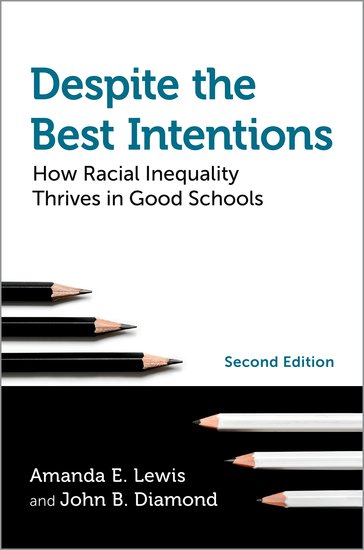
Despite the Best Intentions

How Racial Inequality Thrives in Good Schools
2025

On the surface, Riverview High School looks like the post-racial ideal. Serving an enviably affluent, diverse, and liberal district, the school is well-funded, its teachers are well-trained, and many of its students are high achieving. Yet Riverview has not escaped the same unrelenting question that plagues schools throughout America: why is it that even when all of the circumstances seem right, black and Latino students continue to lag behind their peers?

Through five years' worth of interviews and data-gathering at Riverview, John Diamond and Amanda Lewis have created a rich and disturbing portrait of the achievement gap that persists more than fifty years after the formal dismantling of segregation. As students progress from elementary school to middle school to high school, their level of academic achievement increasingly tracks along racial lines, with white and Asian students maintaining higher GPAs and standardized testing scores, taking more advanced classes, and attaining better college admission results than their black and Latino counterparts. Most research to date has focused on the role of poverty, family stability, and other external influences in explaining poor performance at school, especially in urban contexts. Diamond and Lewis instead situate their research in a suburban school, and look at what factors within the school itself could be causing the disparity. Most crucially, they challenge many common explanations of the 'racial achievement gap, ' exploring what race actually means in this situation, and why it matters.

An in-depth study with far-reaching consequences, Despite the Best Intentions revolutionizes our understanding of both the knotty problem of academic disparities and the larger question of the color line in American society.

Suggested Citation:

Suggested citation

Lewis, A. E., & Diamond, J. B. (2025). Despite the best intentions: How racial inequality thrives in good schools (2nd ed.). Oxford University Press.

Share

How Educational Leaders Sustain Equity Work in a Politically Hostile Environment

2026

Beginning in 2021, legislation targeting Critical Race Theory was introduced and adopted across the United States. Over time, these efforts expanded to include banning books and dismantling diversity, equity, and inclusion (DEI) initiatives in K-12 and higher education. While external pressure has led some educators to scale back their equity-oriented practices, less is known about how equity-focused efforts are maintained in this hostile environment. This paper presents evidence from a national initiative where school districts, universities, and state education departments in eight U.S. locations collaborated to develop pathways for equity-oriented school leadership. Based on interviews, observations, and document reviews, we find that team members used existing civil rights infrastructure (such as equity offices and roles) and institutionalized equity language in official documents (like equity language in principal standards) to legitimize their efforts and protect them from external criticism. As equity language and these offices became targeted, educational organizations responded by strategically reframing their equity work, disconnecting their language from actual practices and appearing to meet new expectations while avoiding unwanted scrutiny.

Suggested Citation:

Suggested citation

Diamond, J. B., Handsman, E., Mosby, J., Molle, D., & Jones, W. (2026). How educational leaders sustain equity work in a politically hostile environment. Peabody Journal of Education, 101(1), 63–76. https://doi.org/10.1080/0161956X.2026.2647662

Share

◆
Publication Type

Immigration Enforcement Actions and Empty Desks: Persistent and Acute Attendance Effects

2026

How do changes in immigration policy affect student attendance? We use student-by-day administrative records from a mid-sized school district to estimate the causal effect of heightened federal immigration enforcement following the January 2025 presidential inauguration on student attendance using a difference-in-differences design. We find that heightened enforcement and immigration enforcement actions (IEAs) cause a substantial and persistent increase in absences among foreign-born students, with the daily probability of absence rising by 2.2-2.4 percentage points (33-36%) relative to a pre-treatment mean of 6.7 percent. These effects reflect both a persistent elevation in absences spanning the full post-treatment period and acute, short-lived spikes on dates proximate to specific enforcement events. The persistent elevation accounts for most of the overall effect and shows little signs of attenuation during our study period. Effects increase nearly monotonically with grade level, consistent with older students exercising greater autonomy over their own attendance decisions. We find no evidence of spillover effects onto U.S.-born students, including those in mixed-nativity households, though limited statistical power cannot rule out spillovers up to roughly half the magnitude of the main effect. We also show that estimates using more common proxies for student vulnerability, such as MLL status, likely understate the effects experienced by the most directly affected students.

Suggested Citation:

Suggested citation

Camp, Andrew, Jonathon Acosta, Janelle Haire, and Edom Tesfa. (2026). Immigration Enforcement Actions and Empty Desks: Persistent and Acute Attendance Effects. (EdWorkingPaper: 26-1453). Retrieved from Annenberg Institute at Brown University: https://doi.org/10.26300/bz9z-w627

Share

Now We Are Here: Family Migration, Children’s Education, and Dreams for a Better Life

Date & Time
-

Join the Race and Education Research Initiative Seminar Series for a talk with anthropologist Gabrielle Oliveira on her new book, Now We Are Here: Family Migration, Children's Education, and Dreams for a Better Life, winner of the AERA Book of the Year Award. Drawing on ethnographic research with immigrant children and families, Oliveira examines how families navigate schools across borders and the hopes that shape their decisions to migrate. Co-organized with the Brown University Department of Education.

About Gabrielle

Gabrielle Oliveira is an anthropologist of education whose research examines immigration, mobility, and family life across borders, with a focus on children’s education, gender, and transnationalism in the Americas. She is the author of Motherhood Across Borders (NYU Press), winner of the Erickson and Hornberger Book Award and the Council on Anthropology and Education’s Book of the Year Award, and Now We Are Here: Family Migration, Children’s Education, and Dreams for a Better Life (Stanford University Press) which just won the AERA Book of the Year Award.

Oliveira’s ethnographic work spans multiple countries and centers on immigrant children and families navigating educational systems, including dual language programs. She is the recipient of multiple grants from the Spencer Foundation and the WT Grant Foundation. Gabi was a Radcliffe Fellow in 2024–2025, and she is currently working on a third book based on research with Venezuelan immigrant children in public schools in northern Brazil. Her work appears in leading journals across anthropology and education, and she has been featured in outlets such as the New York Times, NPR, BBC, Univision, and TV Globo.

Share

Ash Horn

Research Associate
She/Her
Image
Ash Horn
Biography

Ash Horn is a Research Associate at the Annenberg Institute, where she supports research on the teacher workforce, including teacher retention, as well as work examining how broader environmental and community conditions shape educational experiences and outcomes. She is particularly interested in making research useful to policymakers and practitioners.

Prior to joining Annenberg, Ash spent seven years at the Patient-Centered Outcomes Research Institute (PCORI), where she worked across research, data analytics, and program and portfolio management to support patient-centered comparative effectiveness research. Her experience at PCORI shaped her interest in how research organizations generate, synthesize, and mobilize evidence to improve policy and practice.

Ash’s interest in education policy also grew through her work with Acorn, an education-focused nonprofit she co-founded. While at Acorn, she co-hosted the EduPod podcast, which brought together teachers and education leaders to discuss challenges in education policy and practice. During graduate school, she conducted research on college access and Children’s Savings Account programs with Providence Promise.

Her broader research interests include education policy, educational opportunity and inequality, the teacher workforce, and how research and evidence can inform policy and practice.

Ash holds an A.M. in Urban Education Policy from Brown University and a B.S. from the University of California, Berkeley.

Antonia Vazquez

Postdoctoral Research Associate
Image
Antonia Vazquez
Biography

Antonia Vazquez is a Postdoctoral Research Associate at the Annenberg Institute at Brown University. Antonia is an applied microeconomist whose research uses experimental and quasi-experimental methods to study the economics of education and health economics. She is drawn to Annenberg’s mission of connecting rigorous evidence to educational practice and policy, and to working alongside a community of researchers committed to translating findings into real improvements for students and schools.

Her latest research, “Can We Save Failing Schools? Evidence From Los Angeles,” studies a lawsuit settlement in the Los Angeles Unified School District and finds that the reforms reduced suspension rates and improved school climate. She has secured competitive grants from the Spencer Foundation, Arnold Ventures, and The Agency Fund, and her work has been published in the Review of Economics and Statistics.

Antonia completed her Ph.D. in Public Policy at the University of Texas at Austin. Before her Ph.D., she was a Fox International Fellow at Yale University. She holds an M.A. in Economics from Universidad de San Andrés in Argentina and a B.A. in Business from UNICEN in Argentina.

Saloni Gupta

Assistant Professor
Image
Saloni Gupta
Biography

I am the Jonathan M. Nelson Assistant Professor of Entrepreneurship and Education at Brown University.

My work lies at the intersection of education, innovation, and economic development. I examine how education systems develop higher-order skills for a changing labor market and how new technologies influence the scaling of educational innovations.

I am an invited researcher at the J-PAL's Science for Progress Initiative. My work is supported by the National Academy of Education/Spencer Foundation , the King Center on Global Development at Stanford University, the Learning for All Initiative (LAI) at J-PAL, Weiss Fund for Development Economics, and the What Works Hub for Global Education.

I completed my Ph.D. in Economics and Education at Teachers College, Columbia University in 2024 and a postdoc at the Stanford King Center on Global Development in 2025.

Effects of Unrestricted Gifts in Higher Education: Evidence from MacKenzie Scott’s Yield Giving with Silvia Robles, Anjali Pai, Aizat Nurshatayeva, and Anna Paulson

Date & Time
-

Annenberg’s Education Workshop Seminar Series is an hour-long “works in progress” seminar centered on empirical research related to education and education policy. Seminars are typical academic presentations intended for a broad academic audience. Speakers come from a variety of disciplinary traditions and we seek to be inclusive to a broad, multi-disciplinary audience.


We invite faculty, postdocs, students, and research staff from across the university who are interested in empirical research in education to participate.


Event speakers: Silvia Robles, Anjali Pai, Aizat Nurshatayeva, Anna Paulson (present remotely)
Event Title: Effects of Unrestricted Gifts in Higher Education: Evidence from MacKenzie Scott’s Yield Giving
 

Share

Petter Berg

Post-Doctoral Researcher
Image
Petter Berg
Biography

Hi! My name is Petter Berg, and I am an applied microeconomist working primarily on topics related to education across both developed and developing countries. My recent work focuses on the behavior and performance of private providers in education markets.

During the 2026-27 academic year, I will be a postdoctoral researcher at Brown University (Dept. of Economics and the Watson School of International and Public Affairs). I will join Stockholm University as an assistant professor in Fall 2027.