Urban Conference

Date & Time
-

Community Engaged Research, in its various names and configurations, is at a crucial juncture. There has been a joyful expansion of creative methodologies that adhere to values of community, shared power, and the meaningful participation and leadership by those most impacted by systems of oppression in the co-construction of knowledge. There is also a current risk of core terminology being co-opted and utilized by people and institutions that don’t adhere to long-held values of solidarity and robust action.

This year’s conference emphasizes that community engaged research is essentially about shared meaning making which is at the core of co-creating our society and is critically important to a well-functioning democracy. We acknowledge the breadth and diversity of journeys that lead to community engaged research while always holding onto core values.

Share

Projects

School District Responses to State and Federal Policy Change


In this project, we are studying how school districts across the U.S. are responding to state and federal educational policy changes, particularly related to issues of educational equity.

Principal Pathways and Educational Equity


In this project, we are engaged in a national study of the development of principal pathways focused on producing equitable outcomes for all young people.   

Rhode Island Principal Landscape Study


Through a partnership with the Rhode Island Department of Education and local principal preparation providers, we are working to better understand principal pathways in the state.

Mapping Rhode Island Youth-Serving Nonprofits


In this project, we are mapping the terrain of Rhode Island nonprofit organizations to better understand their distribution across the state. We are developing online information tools for local residents about the resources that exist in their communities.

Understanding the Implications of the Changing Immigration Policy Landscape


In partnership with local education providers, we are examining how the changing landscape of immigration policy is impacting students and school districts, and how those districts are responding to these external forces.

Biography
Sidney is from San Antonio, Texas originally, but lived in Austin, Texas for the years she completed her bachelor degree at the University of Texas at Austin in Sociology and Women, Gender, and Sexuality Studies. During her time at the University of Texas, Sidney worked as an undergraduate research assistant for a research lab consisting of a collaborative of scholars dedicated to advancing anti-racist research using critical quantitative methodologies. In her role, she supported initial data cleaning and assisted in creating a codebook, recruited research participants across Texas, supported focus group interviews, presented at conferences, and managed the project’s social media account. Her educational and professional background prompted her to think about how the changing political landscape is shaping higher education in the current moment, and how that shaping is both racialized and gendered. Sidney enjoys reality television, volleyball, reading, and her two cats! Her research interests include: Gender and Sexuality, Race and Ethnicity, Education, and Education Policy.

Disrupting White Supremacy and Anti-Black Racism in Educational Organizations

White supremacy and anti-Black racism are deeply embedded in educational organizations and disrupting them is key to creating more racially just schools. This essay details how the regular practice of organizational routines reproduces racial domination and subordination. We argue that combining critical perspectives on race with organizational improvement approaches can help disrupt this reproductive process. More specifically, educators can engage in critical reflection and action to interrupt, deconstruct, and redesign organizational routines in ways that challenge and hopefully undermine white supremacy and anti-Black racism in schools. We highlight how this approach could help create more racially just educational contexts.

Suggested Citation:

Suggested citation

Diamond, J. B., & Gomez, L. M. (2023). Disrupting white supremacy and anti-Black racism in educational organizations. Educational Researcher, 52(4), 209–218. https://doi.org/10.3102/0013189X231161054

Share

Defending the Color Line: White Supremacy and the Legacy of Brown

2024

Building on W. E. B. Du Bois’s color line concept, I argue that white supremacy is deeply embedded in U.S. educational organizations and that White racial actors, opportunity hoarding, and the cultivation of racial ideology and racial ignorance help sustain it. In doing this, I seek to move away from the aspirational progress narratives often associated with Brown to the racial hierarchies and various forms of harm that schools reproduce, even when they are racially diverse. Taking the recent attacks against critical race theory as a backdrop, I argue that educational institutions not only contribute to educational inequity but also socialize people into relations of racial domination and subordination through organizational practices and individual actions. In the article’s conclusion, I highlight my efforts to disrupt these patterns and work toward the creation of more liberatory education spaces.

Suggested Citation:

Suggested citation

Diamond, J. B. (2024). Defending the color line: White supremacy and the legacy of Brown. Educational Researcher, 53(3), 135–145. https://doi.org/10.3102/0013189X231216450

Share

◆
Publication Type

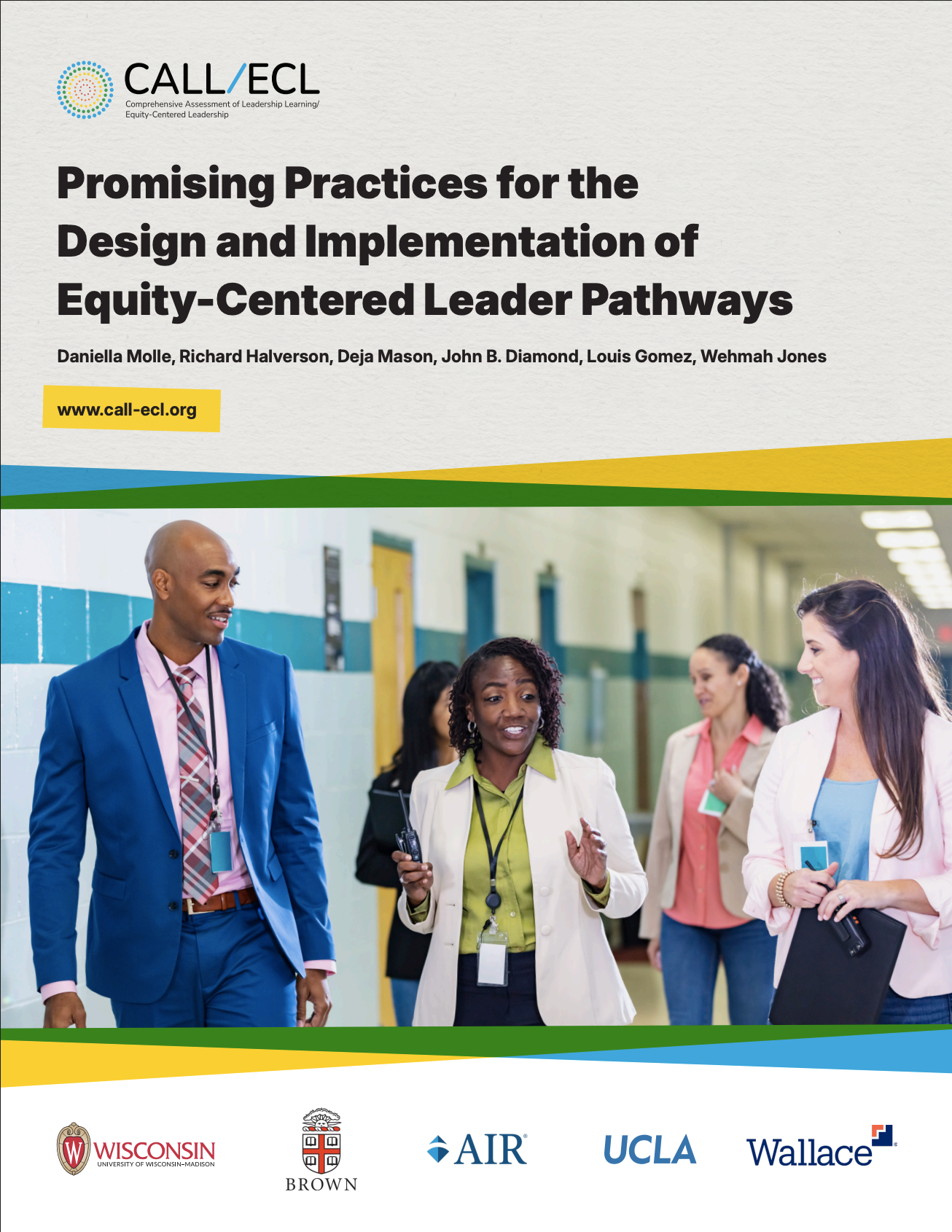
Promising Practices for the Design and Implementation of Equity-Centered Leader Pathways

2026

Building a more robust pipeline of school principals who are prepared to lead effectively and advance educational equity can be a powerful lever for change in school districts. Research shows that strong school leaders can have a positive impact on student achievement and attendance. They foster better teaching as well as a positive and supportive school climate.

Starting in 2021, The Wallace Foundation has supported eight large urban school districts in a six-year initiative to help develop equity-centered principals who are leading for all students. The vision is for public schools located in areas where many students come from families with incomes below the poverty line to have an effective principal. This report identifies major themes and promising practices emerging from the first few years of that effort so far in Baltimore, Columbus (Ohio), the District of Columbia, Fresno, Jefferson County (Kentucky), Portland (Oregon), San Antonio, and Winston-Salem/Forsyth County.

The major themes are:

  1. Districts addressed challenges in the work as “opportunities for design.” That is, careful reflection by district leaders led to new structures and routines intended to strengthen district capacity to advance equity-centered leadership in school systems.
  2. Creating coherence across systems was both a persistent challenge and a key accomplishment. Many promising practices took hold not only because they were innovative, but because they also sought to connect previously separate systems to a shared vision for equity-centered leadership across departments, roles, and external partnerships.
  3. Districts prioritized the development of relationships and human capital through affinity groups, district-led academies, and leadership shadowing routines. The goal was ultimately to create favorable conditions for distributed leadership in schools and local ownership of equity efforts.

The new research findings build upon earlier, Wallace-supported work demonstrating that well-designed principal pipelines offer an affordable and effective way for large urban districts to improve schools. Each participating district in the ECPI developed its own definition of equity and equity-centered leadership, and engaged in practices designed to remove barriers and create the conditions for student success, such as:

  • Providing access to rigorous, culturally relevant instruction
  • Creating inclusive environments for students and families
  • Actively challenging assumptions and practices that reproduce inequality

The specific strategies embraced by participating districts to place school leaders at the center of this work vary widely, according to the new report. For example, Baltimore City Public Schools developed a one-year, home-grown principal residency program tailored to the unique context and needs of the city’s schools. The program includes job-embedded leadership development, monthly professional learning seminars, and on-demand coaching.

Columbus City Schools adopted a new definition of equity and drew on that to inform a new Portrait of an Equity-Centered Leader. Key elements of the portrait are embedded in principal preparation and ongoing professional learning provided with support from The Ohio State University. Meanwhile, the Fresno Unified district developed leadership affinity groups to more effectively recruit, support, and retain principals and assistant principals of color. The affinity groups provide professional learning, mentoring, and other support.

For other school districts eyeing similar efforts or already engaged in them, the report provides practical strategies to anticipate and navigate the challenges that will inevitably arise. Indeed, sustaining equity-centered leadership requires systems that not only support school leaders but shift the culture of learning and relationship-building in schools and districts. 

The researchers also stressed that district leaders should help ensure that their efforts bring about meaningful and lasting change by strengthening communication and everyday interactions between educators, students, and families. 

Suggested Citation:

Suggested citation

Molle, D., Halverson, R., Mason, D., Diamond, J.B., Gomez, L. M., & Jones, W. (2026). Promising practices for the design and implementation of equity-centered leader pathways. https://doi.org/10.59656/EL-LS9421.001

Share