◆
Publication Type

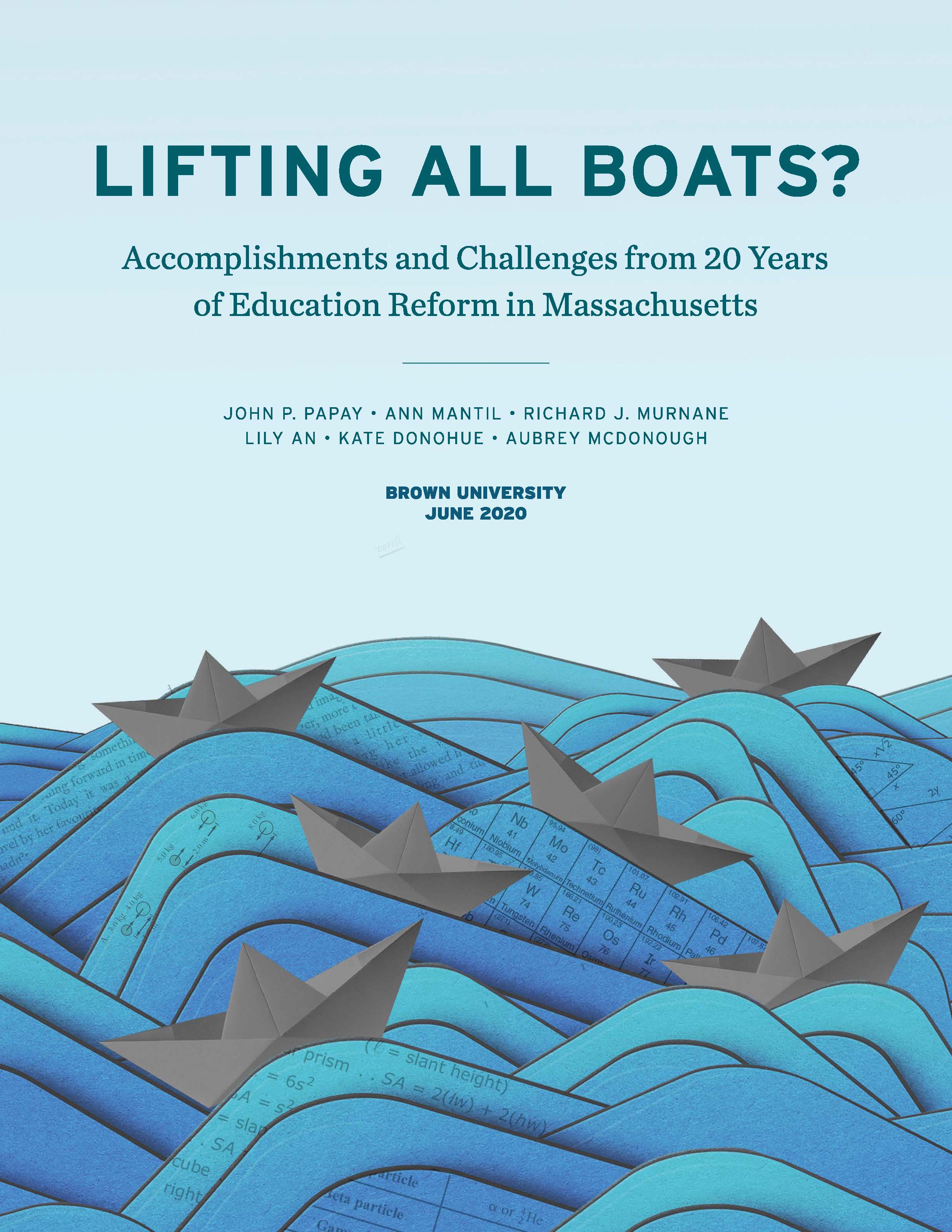
Lifting all Boats?

2020

Executive Summary:

PDF

Since the passage of the Massachusetts Education Reform Act in 1993, the Commonwealth has been seen as a national leader in education reform. The legislation introduced statewide learning standards and the Massachusetts Comprehensive Assessment System (MCAS) tests, and provided large increases in funding for K-12 education. We explore the high school experiences, post-secondary educational attainments, and labor market earnings of Massachusetts public school students since the early 2000s, when MERA was fully implemented.

New state-level initiatives, including the passage of the Student Opportunity Act in 2019 and the introduction of the Next-Generation MCAS tests, aim to advance the state’s goal of providing all students with the skills and knowledge to thrive in today’s complex and changing society. The COVID-19 pandemic has increased awareness of the dramatic inequalities in students’ opportunities and schools' resources and underscores the need to re-envision the role of public schools in promoting equity. Doing so requires a robust consideration of the progress of public education in the Commonwealth over the past several decades.

Implications

Taken together, our findings suggest that the public education system in the Commonwealth has made substantial progress over the past two decades but has a long way to go in equalizing opportunities for students from key subgroups. We find inequalities at all points in the Commonwealth’s educational pipeline. Closing gaps in high-school performance and postsecondary educational attainments could dramatically reduce current levels of income inequality.

Both the state’s public K-12 and higher education systems need to work to ensure that students who want to pursue post-secondary education have access to college, enter college ready to succeed, and receive the supports necessary during college to leave with a valuable credential. For K-12, improved MCAS scores should follow from better educational opportunities and increases in critical skills. This requires that all students experience high-quality instruction designed to achieve student mastery of core academic and social skills, as opposed to test-taking strategies. For higher education, we note that in-state public colleges have a critical role to play in equipping low-income students with the skills and educational credentials to succeed in the labor market.

Suggested Citation:

Suggested citation

Papay, J. P., Mantil, A., Murnane, R. J., An, L., Donohue, K., & McDonough, A. (n.d.). Lifting all boats? Accomplishments and challenges from 20 years of education reform in Massachusetts. Educational Opportunity in Massachusetts, Annenberg Institute at Brown University. https://annenberg.brown.edu/publications/lifting-all-boats
Share

◆
Publication Type

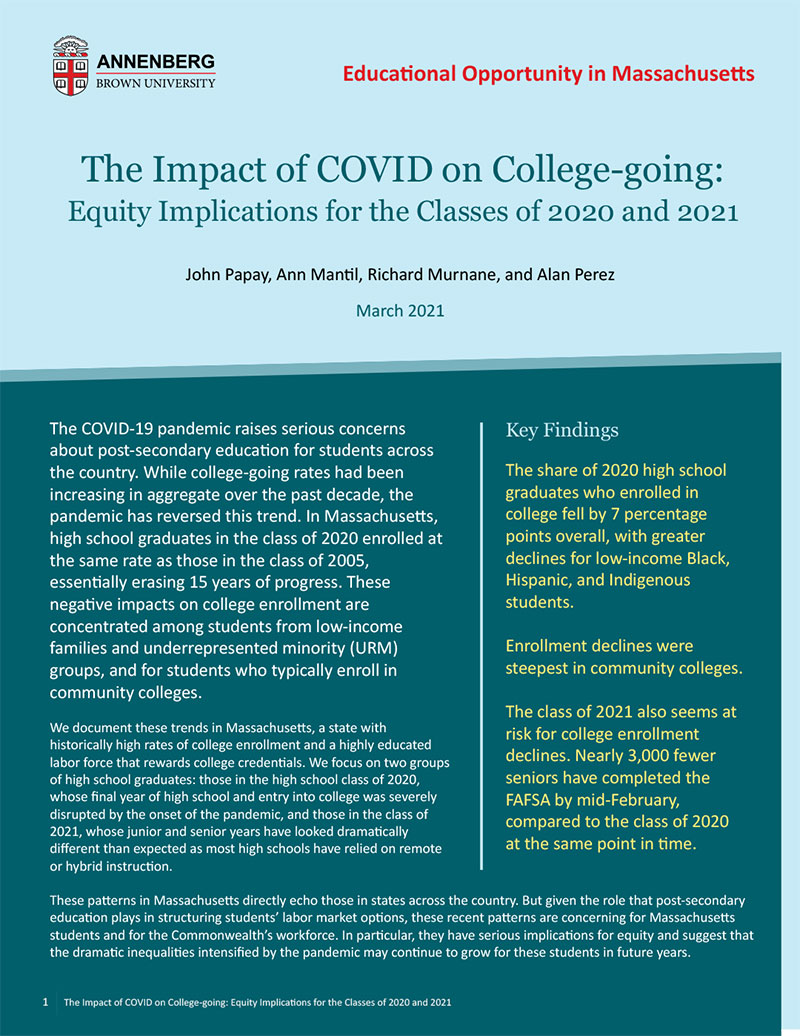
The Impact of COVID on College-going: Equity Implications for the Classes of 2020 and 2021

2021

The COVID-19 pandemic raises serious concerns about post-secondary education for students across the country. While college-going rates had been increasing in aggregate over the past decade, the pandemic has reversed this trend. In Massachusetts, high school graduates in the class of 2020 enrolled at the same rate as those in the class of 2005, essentially erasing 15 years of progress. These negative impacts on college enrollment are concentrated among students from low-income families and underrepresented minority (URM) groups, and for students who typically enroll in community colleges.

We document these trends in Massachusetts, a state with historically high rates of college enrollment and a highly educated labor force that rewards college credentials. We focus on two groups of high school graduates: those in the high school class of 2020, whose final year of high school and entry into college was severely disrupted by the onset of the pandemic, and those in the class of 2021, whose junior and senior years have looked dramatically different than expected as most high schools have relied on remote or hybrid instruction.

These patterns in Massachusetts directly echo those in states across the country. But given the role that post-secondary education plays in structuring students’ labor market options, these recent patterns are concerning for Massachusetts students and for the Commonwealth’s workforce. In particular, they have serious implications for equity and suggest that the dramatic inequalities intensified by the pandemic may continue to grow for these students in future years.


Key Findings

  • The share of 2020 high school graduates who enrolled in college fell by 7 percentage points overall, with greater declines for low-income Black, Hispanic, and Indigenous students.
  • Enrollment declines were steepest in community colleges.
  • The class of 2021 also seems at risk for college enrollment declines. Nearly 3,000 fewer seniors have completed the FAFSA by mid-February, compared to the class of 2020 at the same point in time.

Suggested Citation:

Suggested citation

Papay, J. P., Mantil, A., Murnane, R. J., & Perez, A. (2021). The impact of COVID on college-going: Equity implications for the classes of 2020 and 2021. Educational Opportunity in Massachusetts, Annenberg Institute at Brown University. https://annenberg.brown.edu/publications/impact-covid-college-going-equity-implications-classes-2020-and-2021-0

Share

On the Threshold: Impacts of Barely Passing High-School Exit Exams on Post-Secondary Enrollment and Completion

2022

Many states use high-school exit examinations to assess students’ career and college readiness in core subjects. We find meaningful consequences of barely passing the mathematics examination in Massachusetts, as opposed to just failing it. However, these impacts operate at different educational attainment margins for low-income and higher-income students. As in previous work, we find that barely passing increases the probability of graduating from high school for low-income (particularly urban low-income) students, but not for higher-income students. However, this pattern is reversed for 4-year college graduation. For higher-income students only, just passing the examination increases the probability of completing a 4-year college degree by 2.1 percentage points, a sizable effect given that only 13% of these students near the cutoff graduate.

Suggested Citation:

Suggested citation

Papay, J. P., Mantil, A., & Murnane, R. J. (2022). On the threshold: Impacts of barely passing high-school exit exams on post-secondary enrollment and completion (EdWorkingPaper No. 22-627). Annenberg Institute at Brown University. https://doi.org/10.26300/rhx2-yv60

Share

◆
Publication Type

Building Stronger Community College Transfer Pathways

Evidence from Massachusetts

2022

Produced by the research–practice partnership, Educational Opportunity in Massachusetts, this study explores transfer patterns for 10 cohorts of students entering community colleges soon after high school. The findings provide evidence of how policies adopted to make the transfer process more transparent and predictable have impacted different subgroups of students, both in terms of the probability that they will transfer to a four-year institution, and the probability that those who do transfer subsequently earn four-year degrees.

Along with 2021 MassINC-Northeastern University research on the labor market value of community colleges and a 2022 MassINC study quantifying return-on-investment in community colleges, this research is a powerful example of the invaluable insight policymakers can glean from longitudinal data following students across systems.

The extensive research reported in this policy brief was supported by the Institute of Education Sciences, US Department of Edu­cation, through grant R305H190035 to Brown University. The Boston Foundation provided additional funding for the production of this policy brief.

Suggested Citation:

Suggested citation

Murnane, R. J., Willett, J. B., Papay, J. P., Mantil, A., Mbekeani, P. P., & McDonough, A. (2022). Building stronger community college transfer pathways: Evidence from Massachusetts. MassINC. https://massinc.org/research/building-stronger-community-college-transfer-pathways/

Share

◆
Publication Type

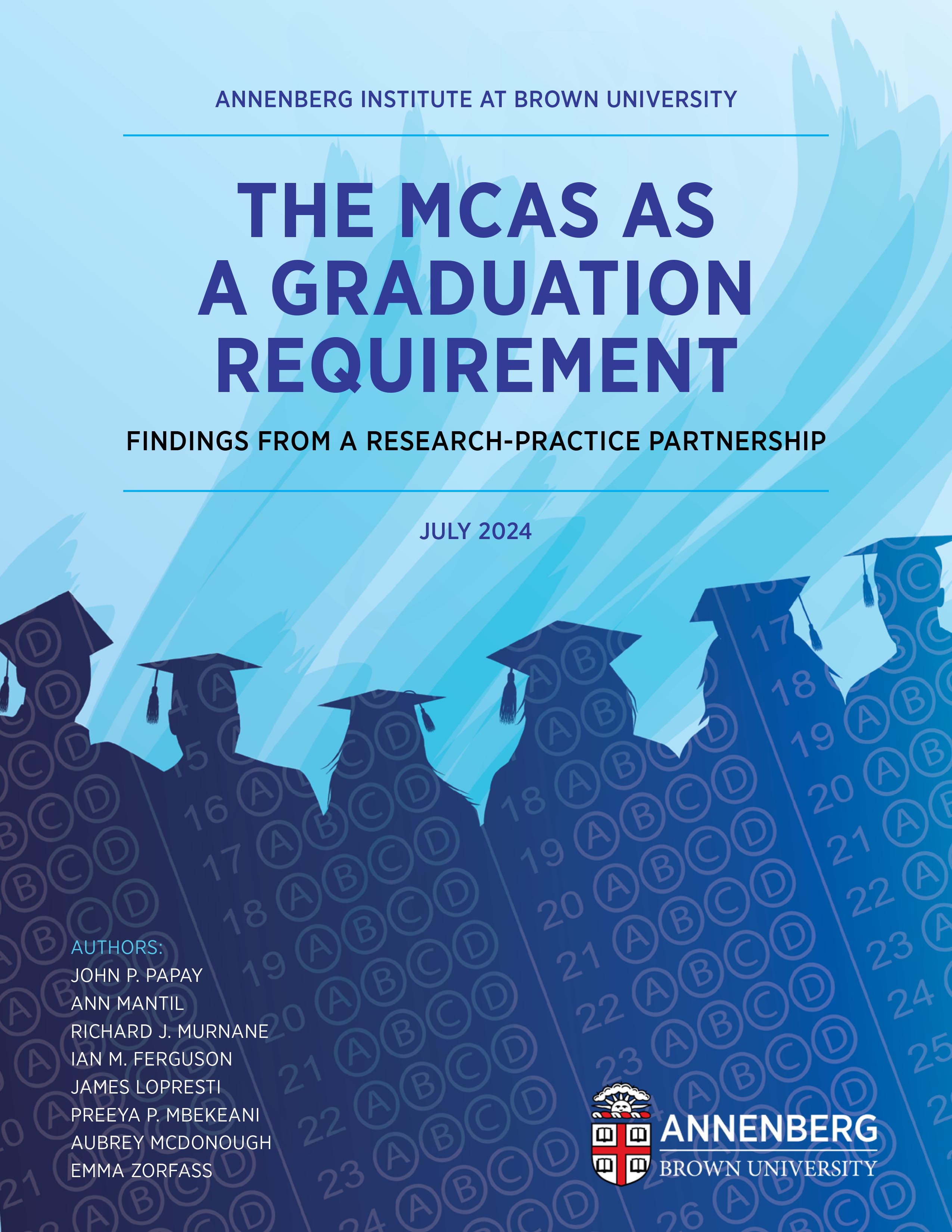
The MCAS as a Graduation Requirement

2024

Executive Summary:

Across Massachusetts, legislators, policymakers, educators, families, and communities are engaged in important conversations about whether to continue using student performance on the MCAS tests as part of the state’s high-school graduation requirements. These are part of broader discussions about the best ways to provide all students with the knowledge, skills, and capacities they need to succeed when they leave high school and enter college or the labor force.

Unlike most states, Massachusetts does not specify a set of courses that students must pass to graduate from high school. Instead, it relies on scores on tests of mathematics, English language arts, and science as a central part of the state’s “competency determination” (CD) process. Students take these tests for the first time early in high school, and they are targeted to 10th grade content standards. Students who do not meet the CD testing standard can retake the tests repeatedly and can appeal if they do not pass on retest.

Nationally, there is mounting evidence that we need high standards for all students and, with appropriate supports, almost all students can meet these standards. Lowering academic expectations for students exacerbates inequality. However, there are clear disagreements over the best ways to ensure that educators raise expectations and how to provide the requisite supports, and open questions about whether the test-based competency determination policy accomplishes this goal.

One thing that is sometimes missing from these conversations is a grounding in the available evidence. In this document, we synthesize lessons drawn from our 15-plus years of research on educational opportunity and state testing in Massachusetts.

Suggested Citation:

Suggested citation

Papay, J. P., Mantil, A., & Murnane, R. J. (2024). The MCAS as a graduation requirement. Educational Opportunity in Massachusetts, Annenberg Institute at Brown University. https://annenberg.brown.edu/edopportunity/mcas-graduation-requirement

Share

Introducing a High School Exit Exam in Science: Consequences in Massachusetts

2025

Preparing students for science, technology, and engineering careers is an urgent state policy challenge. We examined the design and roll-out of a science testing requirement for high school graduation in Massachusetts. While science test performance improved over time for all demographic subgroups, we observed rising inequality in failure rates and retest success. English learners, almost 8% of all test takers, accounted for 53% of students who never pass. We found large differences by family income, even conditional on previous test scores, that raise equity implications. Using a regression-discontinuity design, we showed that barely passing the exam increased high school graduation and college outcomes of students near the score threshold, particularly for females and students from higher-income families.

Suggested Citation:

Suggested citation

Mantil, A., Papay, J. P., Mbekeani, P. P., & Murnane, R. J. (2025). Introducing a high school exit exam in science: Consequences in Massachusetts. American Educational Research Journal, 62(6), 1100–1132. https://doi.org/10.3102/00028312251367669

Share

◆
Publication Type

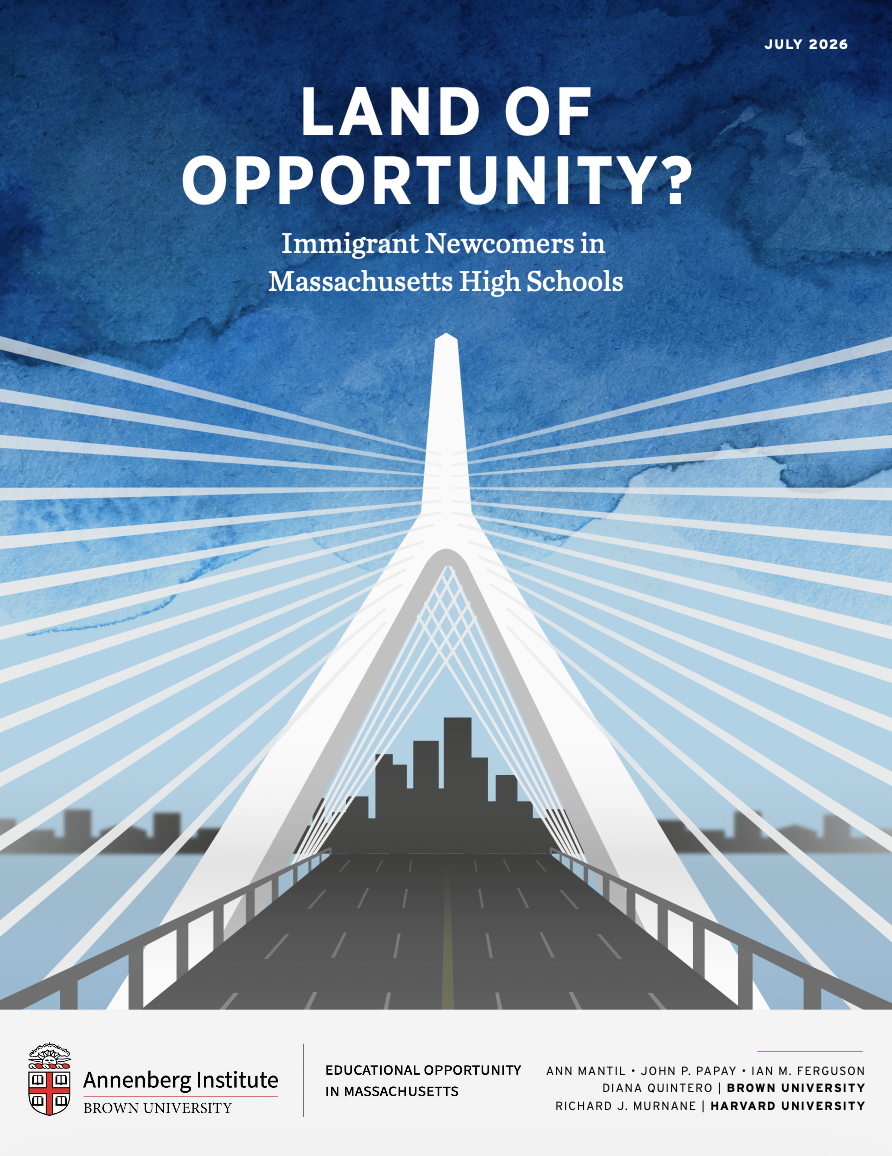
Land of Opportunity?

2026

Executive Summary:

Recently arrived immigrant students, commonly referred to as newcomers, comprise an important and ever-evolving group of students in Massachusetts’ public high schools. In 2023-24, one in 12 new high-school students (and one in six in urban high schools) was a newcomer.

These high-school newcomers - here defined as English learners in their first 12 months of schooling in the United States - differ from other vulnerable student groups in key respects. More than half are not present when the school year begins. Some arrive without their parents, scarred by exposure to trauma and violence and perilous journeys to the U.S. Half are 16 years or older when they first set foot in a Massachusetts high school; for many, financial insecurity and debt result in work obligations that make school attendance and engagement even more challenging.

In this follow-up to our 2023 report, Rising Numbers, Unmet Needs, we focus on how districts serve this group of students. Across Massachusetts, districts are struggling to accomplish the dual goals of helping newcomers make progress towards English language proficiency and master the academic content in the state’s curriculum frameworks. Particularly for those newcomers who arrive in high school with very limited English language skills and/or gaps in their prior learning, the path to high-school graduation is extremely demanding, and many do not complete it.

Immigrant youth contribute important linguistic and multicultural diversity to Massachusetts public schools. Many have risked and suffered a great deal to access educational opportunities in the U.S. Their arrival in the Commonwealth offers great potential for enriching the education of their peers and for building a strong labor force for the decades ahead. However, whether these potential benefits are realized will depend to a large extent on the success of the state’s public schools in welcoming and educating these newcomers well. 

Suggested Citation:

Suggested citation

Mantil, A., Papay, J. P., Ferguson, I. M., Quintero, D., & Murnane, R. J. (2026). Land of opportunity? Immigrant newcomers in Massachusetts high schools. Annenberg Institute at Brown University. https://annenberg.brown.edu/publications/land-opportunity

Share