A methods paper comparing randomization strategies in college field experiments, finding that individual-level assignment holds up better against contamination than expected — with practical guidance for balancing power and risk.
A four-year study of an AI text-messaging chatbot at a large urban public university, examining what makes such systems sustainable and where their effects on students actually show up.
A pre-registered experiment finding that AI chatbot outreach in large undergraduate courses raised students' final grades and increased their use of academic supports like tutoring.
An evaluation of a year-long program pairing Woonsocket High School students with Brown medical students and resident physicians, finding gains in college motivation, medical knowledge, and comfort with physicians.
A brief on summer melt — when college-intending graduates never enroll — identifying four evidence-based models districts can use to keep students on track: nudges, counselor outreach, peer mentoring, and summer bridge programs.
A report tracing how Massachusetts' SUCCESS initiative — a first-of-its-kind state investment in wraparound support across all 15 community colleges — moved from budget line to practice on campuses.
Two large experiments testing an AI chatbot's outreach to college students, finding it works best for discrete, time-sensitive administrative tasks like financial aid forms and registration holds.
A study using the 2008–18 Baccalaureate and Beyond data, finding that parental education — especially parents' graduate degrees — predicts whether students enroll in graduate school and which credentials they pursue.
A study of Achieve Atlanta's place-based scholarship, finding it didn't shift college enrollment at the eligibility thresholds but substantially improved persistence and four-year degree completion among students who enrolled.
A study of whether private scholarship awards actually increase what students receive, or get offset by reductions in institutional and other aid — a question with direct stakes for scholarship providers.
A handbook chapter reviewing the economics literature on college costs and financial aid — how price, aid design, and complexity shape which students enroll, where they go, and whether they finish.
A handbook chapter reviewing the economics literature on nonfinancial barriers to college — from narrow interventions to comprehensive programs and systemic solutions — and what the evidence says about closing access gaps.
Produced through Educational Opportunity in Massachusetts, this study follows ten cohorts of community college entrants to assess how transfer policies affected who moves to four-year institutions and who earns degrees.
A national experiment with roughly 10,000 undergraduates testing text-message nudges to encourage FAFSA re-filing — finding earlier filing for some students, but no lasting gains in aid, persistence, or attainment.
An Annenberg study finding that barely passing the Massachusetts math exit exam changes outcomes — but at different points in the educational pipeline for low-income and higher-income students.
A brief on how schools can help students navigate college choices — what raises enrollment, what guidance on where to apply matters most, and which common strategies the evidence doesn't support.
A large-scale study of text message campaigns encouraging low-income students toward college, finding no overall effect nationally — but meaningful gains in Texas, where messages came from senders students already knew.
A randomized trial of AI chatbot outreach to incoming college students, finding gains concentrated among would-be first-generation students in financial aid, course registration, and fall enrollment.
A Boston Globe editorial on why too few Massachusetts community college students transfer to four-year schools, and what dual admissions and clearer transfer pathways could change.
Jordan Kostiuk and Jesse Morin will discuss research on educational inequality, exploring factors that shape unequal educational experiences and outcomes through an empirical education policy lens.
This talk will examine how college admissions policies affect Asian American applicants, exploring questions of equity, access, and the ways admissions practices shape opportunities in higher education.
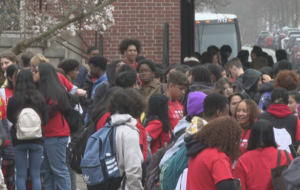
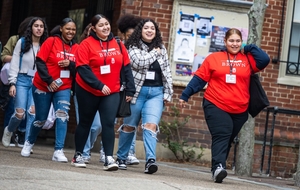
Brown News covers College Day, an Annenberg-organized event bringing nearly 350 high schoolers from Providence, Central Falls, and Pawtucket to campus to explore their post-secondary options.
An Annenberg report tracing how Massachusetts' SUCCESS student support initiative moved from budget allocation to practice across 15 community colleges, drawing on interviews with state leaders, administrators, and program staff.