Brown Tutoring Corps

Looking for the Hub?

Current tutors can access tutoring information and adjust their availability on the BTC Hub.

About the BTC

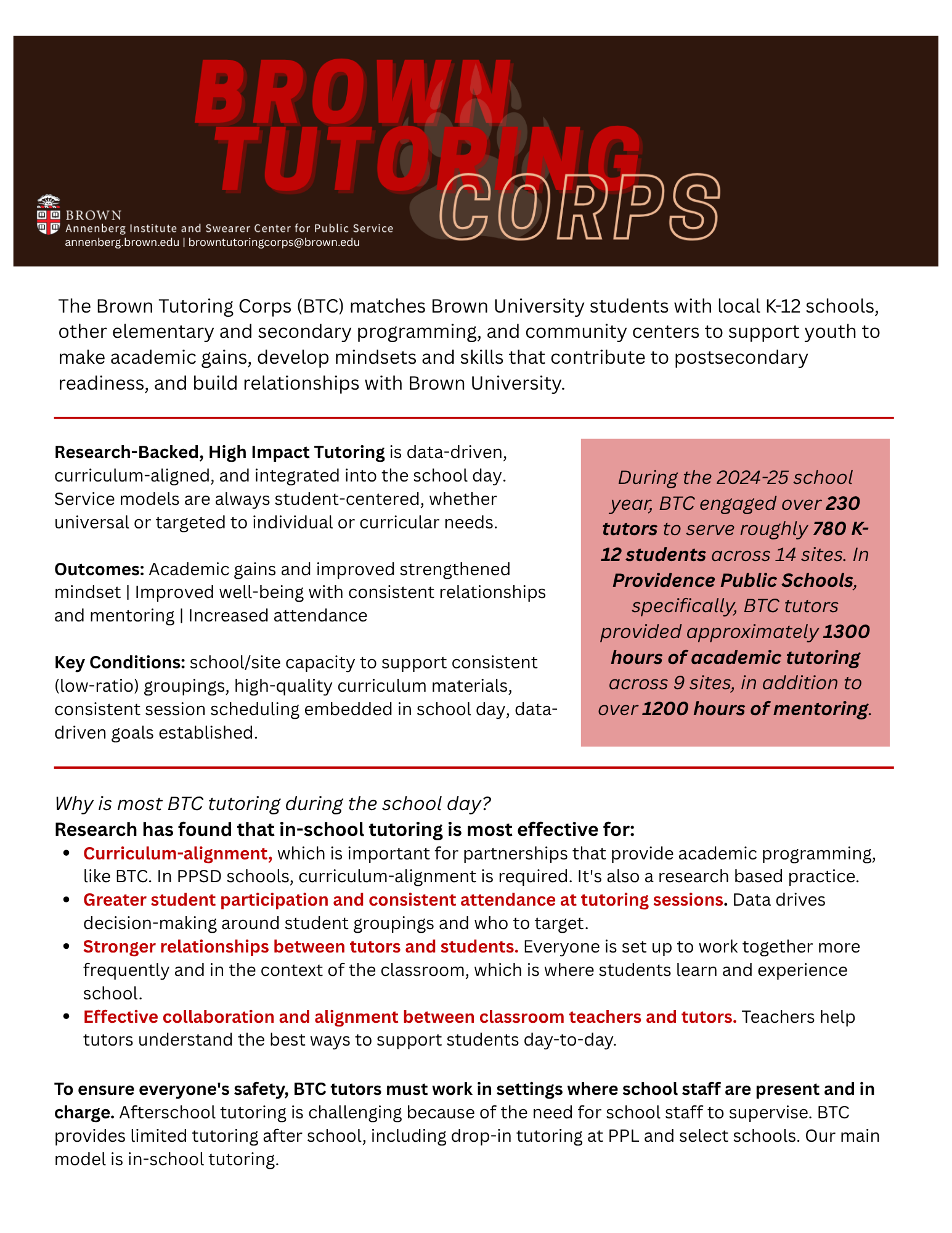
The Brown Tutoring Corps (BTC) mobilizes Brown University students in local K-12 schools and other elementary and secondary programming to support youth to make academic gains, develop mindsets and skills that contribute to postsecondary readiness, and build relationships with Brown University.

A collaboration between the Annenberg Institute and the Swearer Center for Public Service at Brown University, the Brown Tutoring Corps (BTC)  is grounded in a research-backed, high-impact tutoring model, partnering with school and district leaders to design programming responsive to schools’ conditions and students’ needs. BTC supports student learning acceleration– through data-driven, targeted curriculum support and enrichment– with strong relationships and mentoring playing significant roles in student experience and outcomes. BTC strives to create an efficient program in which Brown University students work together and become a part of the fabric of the schools they are serving.

The Annenberg Institute’s core mission is to equalize and improve educational opportunities, while the Swearer Center’s primary goal is to make experiential learning central to a Brown student’s education. Fulfilling the goals of both entities, BTC provides an impactful resource to students in the Providence community, and also gives Brown University students an opportunity for meaningful community engagement.

Tutoring is a powerful educational intervention that can support students’ academic, social and emotional needs. However, this resource is often available only to families who can afford to pay for it. We hope to provide support to students and act as another resource to school districts through this initiative.

To learn more about our program, please email browntutoringcorps@brown.edu.

BTC overview for school leaders

Interested in tutoring?

BTC onboards new tutors at the beginning of each Semester. Click here to  receive notice of application deadlines, background check and training requirements.

Brown’s Urban Education Policy (UEP) master’s program prepares students to lead systemic change in urban schools and school systems. Most complete the program in one year, though some choose a two-year extended study option.

How air pollution can harm student achievement and what schools can do to stop it

Date & Time
-

A variety of causal papers have examined how exposure to pollution harms student outcomes. For example, contemporaneous school bus pollution affects students’ test scores and respiratory health (Austin, Heutel and Kreisman 2019; Beatty and Shimshack 2011). High air pollution from sources ranging from highways to Toxic Release Inventory sites increases absences from school (Chung, Liu, and Persico, 2025; Currie et al., 2009; Simon, Heissel, and Persico, 2021) and lowers student achievement (Marcotte, 2017; Simon, Heissel, and Persico, 2021; Venator and Persico, 2021). This talk will survey the literature on the impacts of various health exposures on student outcomes as well as promising evidence on the impacts of school-level interventions to reduce exposure.

Watch the recording:

Share

The global challenge of teaching about environmentalism, climate change, and Planetary Health

Date & Time
-

In this talk, Dr. Gehlbach will explore the unique characteristics, challenges, and opportunities that are intrinsic to Planetary Health education. Without comprehending how the balance of Earth’s systems impact human health, it is hard to imagine how people will change their attitudes, behaviors, and policy priorities in ways that will alter our current trajectory. Planetary Health education encompasses multiple pedagogical tensions. To the extent that this tension can be thoughtfully navigated, learners across the globe are likely to become more engaged in the collective action problem of protecting the environment, addressing climate change, and improving the planet’s health.

Watch the recording:

Share

Impact of school garden programs on health and academic outcomes

Date & Time
-

Although school-based gardening programs for children have consistently been associated with improvements in dietary behaviors, very few randomized controlled studies (RCTs) have evaluated the effects of gardening interventions on clinical health or metabolic outcomes. In this talk, Dr. Davis will highlight the effects of a one-year school-based gardening, nutrition, and cooking intervention (called TX Sprouts) on dietary intake, obesity parameters, metabolic outcomes, and academic performance in over 3,000 primarily low-income and Hispanic elementary school children. In addition, Dr. Davis will also discuss the barriers and strategies needed to sustain and maintain school gardening programs based on implementation data from over 500 schoolteachers across the US.

Watch the recording:

Share

Climate change and the foundations of lifelong development

Date & Time
-

In this talk, Dr. Cuartas will introduce a conceptual framework for understanding how climate change, through its effects on physical environments, societies, communities, and families, can influence young children’s development. He will share findings from a systematic review that synthesizes emerging evidence linking climate change and child development, as well as recent studies providing causal evidence that atypically high temperatures can impair young children’s cognitive and socioemotional skills, which are foundational for later learning. Dr. Cuartas will integrate this evidence to highlight key directions for future research and discuss implications for educational and developmental policies and practices aimed at protecting young children and fostering healthy development across the life course.

Watch the recording:

Share

The Annenberg Institute serves as a central hub for education policy research at Brown University, dedicated to fostering an environment where students, from undergraduates to doctoral candidates, can engage in applied research training that creates measurable impact.

Annenberg’s student and post-graduate programming is designed to bridge the gap between academic theory and real-world policy, equipping the next generation of researchers, practitioners, and policymakers with the tools they need to improve educational outcomes for all.

Learn more about our student and post-graduate programs below: