Publication Type

Despite the best intentions: How racial inequality thrives in good schools.

2024
A study of a well-resourced, integrated suburban high school showing how racial inequality persists despite good intentions.

Suggested Citation:

Suggested citation

Lewis, A. E., & Diamond, J. B. (2024). Despite the best intentions: How racial inequality thrives in good schools (2nd ed.). Oxford University Press. https://doi.org/10.1093/oso/9780197557068.001.0001

Share

◆
Publication Type

Investing in the Future: How Rhode Island Districts are Spending Federal COVID-19 Funding and Why It Matters

2022

Two years after the start of COVID-19, Rhode Island schools continue to grapple with the effects of the pandemic, including shifting operating procedures, continued staff and student absences, and changing health mandates.

Arguably, though, enduring changes to the school system will be determined not by the challenges of pandemic schooling, but by how schools use the vast infusion of federal recovery resources. Elementary and Secondary School Emergency Relief (ESSER) funds are providing almost $200 billion nationally toward COVID-19 recovery in schools over a four-year period, nearly doubling the typical federal K-12 budget.

Rhode Island alone will receive over $645 million in ESSER. Depending on how the money gets spent, this level of funding has the potential to reshape key elements of Rhode Island’s educational system. This brief uses district plans and line-item budgets to highlight patterns in proposed district spending and to identify likely implications for the state.

Our analysis looks at planned spending for the first two waves of funding: ESSER I, released in May 2020, and ESSER II, released in January 2021. Together, these funds add up to $205 million. In future analyses, we will layer in the third and final wave of $373 million ESSER III dollars, just released in March 2022.

Suggested Citation:

Suggested citation

Annenberg Institute at Brown University. (n.d.). Investing in the future: How Rhode Island districts are spending federal COVID-19 funding and why it matters. https://annenberg.brown.edu/publications/investing-future-how-rhode-island-districts-are-spending-federal-covid-19-funding-and

Share

◆
Publication Type

Tracking Rhode Island's COVID-19 Recovery: A First Look at Districts' Strategic Staffing and Personnel Investments

2023

Starting in May 2020, the Elementary and Secondary School Emergency Relief (ESSER) fund transferred billions of dollars through state departments and on to districts to support COVID-19 recovery efforts. The funding, which lasts through 2024, represents the largest one-time infusion of federal dollars ever provided to K-12 school districts and has the potential to reshape key elements of the educational system.

While several studies have examined district ESSER spending plans, this is the first analysis that we are aware of that explores the choices that districts in a single state have made as they spend the funds. Using line-item data from Rhode Island’s district accounting system alongside interviews with district leaders, we investigate overall spending patterns and expenditures in the largest budget categories – personnel, supplies and partners, technology, and operations and facilities.

As of June 2022, the latest date with complete spending information, Rhode Island districts had used $216 million, or about one-third of the total ESSER allocation, a spending rate that placed Rhode Island among the slowest spenders nationwide. If spending continues at the same rate as 2021-22, districts will reach only 65% of the total by the end of the grant period. However, spend rates have increased each year and spending data do not reflect the full set of obligations that districts have contracted but not yet invoiced, making it hard to tell at this stage how district spending will look as we reach the required deadline.

Within spending category, patterns diverge. Halfway through the grant period, only about one-third of budgeted dollars had been spent in the largest categories – personnel and partners/supplies – with much of the money put toward obligations that predated the pandemic, such as existing staff. In contrast, districts had spent about half of the funds budgeted toward technology and facilities on long-term upgrades. Nearly every school in the state is now set up for one-to-one computing and most districts invested in building infrastructure, updating HVAC systems and other health-related facility needs.

In this brief, we focus on dollars spent by traditional (non-charter) districts on staffing and personnel, by far the largest category of ESSER spending. Subsequent briefs will examine other spending areas in greater detail.

We find that ESSER staffing dollars have not yet created large-scale transformation across the state; staffing levels have stayed flat, with districts instead using large percentages of ESSER funds to pay for existing staff. At the same time, the funds have allowed staff members in some districts to take on significant additional responsibilities and additional professional development opportunities, they have funded substitute teacher time and, in some places, they have paid for additional contract workers such as tutors and therapists.

Suggested Citation:

Suggested citation

Annenberg Institute at Brown University. (n.d.). Tracking Rhode Island's COVID-19 recovery: A first look at districts' strategic staffing and personnel investments. https://annenberg.brown.edu/publications/tracking-rhode-islands-covid-19-recovery-first-look-districts-strategic-staffing-and

Share

◆
Publication Type

Tracking Rhode Island's COVID-19 Recovery: District Investments in Curriculum, Professional Learning, and Technology

2023
ESSER Report 3

In a previous brief, we detailed Rhode Island school districts’ use of federal recovery funds for spending on student-facing and administrative personnel. While personnel spending was by far the largest category of ESSER (the Elementary and Secondary School Emergency Relief Fund), district spending also spiked in other key areas. This brief focuses on the ways that ESSER dollars changed district contracting and purchases—specifically how districts have shifted spending in curriculum, professional development, and technology, as a result of the flexibility provided by ESSER funding.

Districts used ESSER funds to increase spending on these key goods and services far above the pre-pandemic averages. While districts increased total expenditures by 16% in the 2021-22 school year, they increased spending in curriculum, technology, and professional development by 66% on average, with some districts more than tripling their spending.

OUR ANALYSIS HIGHLIGHTS THREE KEY FINDINGS:

  1. Districts substantially increased curriculum spending, using the new federal funds in part to respond to state curriculum mandates passed just before the pandemic.
  2. Districts tripled spending on external professional development providers, with the largest increases in urban core districts for services focused on early literacy and multilingual learners.
  3. Districts across the state used ESSER funds to increase technology spending, significantly increasing the quality and availability of individual student devices.

This brief adds to a broader body of work exploring the first two years of ESSER spending. It contributes to the evidence suggesting that districts in Rhode Island faced spending constraints that forced them to spend largely on existing initiatives and staff, as opposed to the new hires or programs that were proposed in initial budget submissions. Our previous brief showed that ESSER personnel funding was largely used to supplement existing staff pay rather than hire new employees. In this brief, we find that districts spent considerable sums on external trainings, coaching, and instructional materials aimed at building capability among existing staff members. These investments in materials and services have the potential to serve as long-term investments that create payoffs that endure beyond the ESSER funding cutoff in 2024; they also represent large bets and shifts in spending patterns that should be tracked and evaluated to monitor their effects over time.

Suggested Citation:

Suggested citation

Annenberg Institute at Brown University. (n.d.). Tracking Rhode Island's COVID-19 recovery: District investments in curriculum, professional learning, and technology. https://annenberg.brown.edu/publications/tracking-rhode-islands-covid-19-recovery-district-investments-curriculum-professional

Share

◆
Publication Type

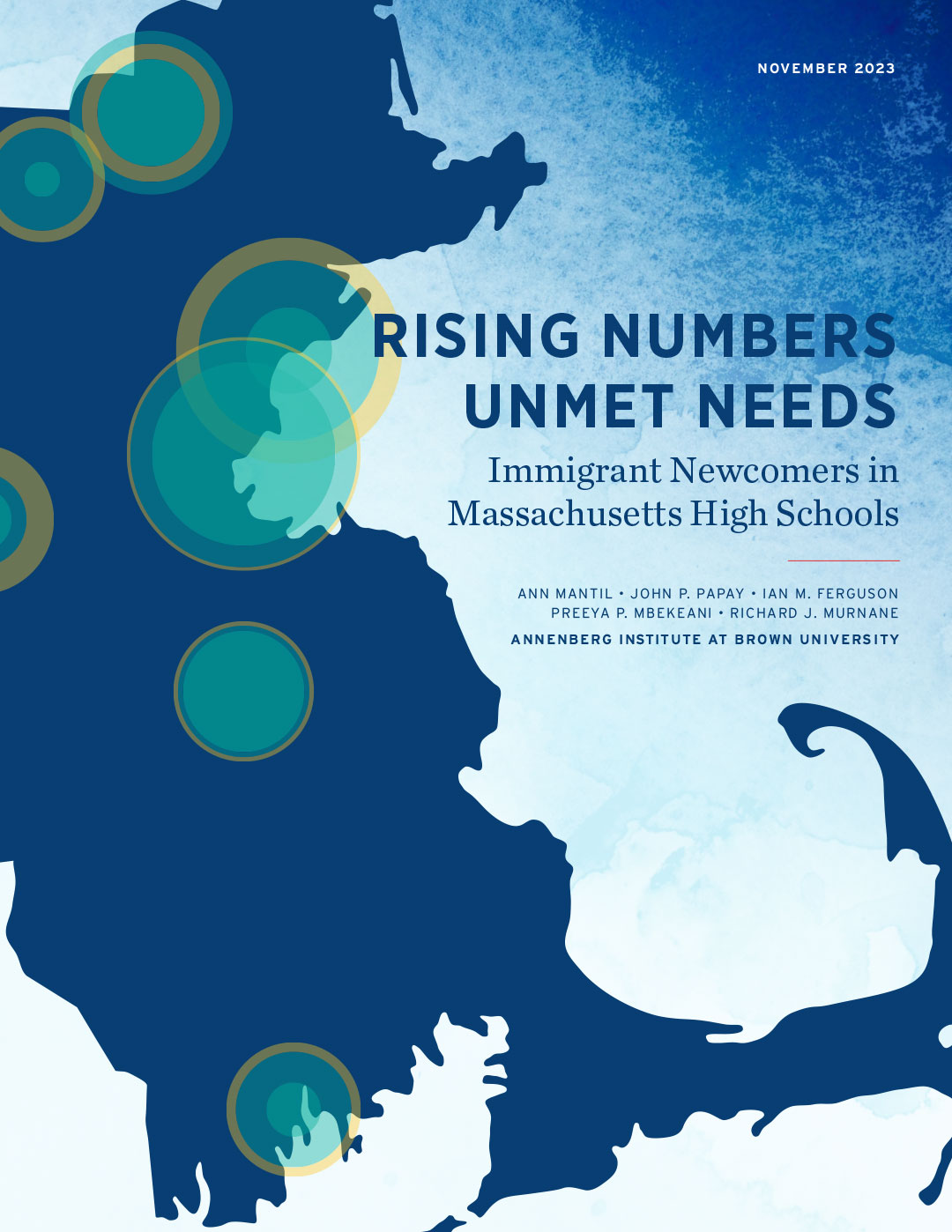
Rising Numbers, Unmet Needs: Immigrant Newcomers in Massachusetts High Schools

2023

Executive Summary:

Massachusetts is widely lauded as a national model for K-12 education, given its consistently high levels of academic achievement and educational attainments. In our 2020 report, Lifting All Boats?, we detailed the substantial progress the state’s educational system has made since the Education Reform Act of 1993, as well as the ways in which focusing on average improvements concealed substantial inequalities throughout the system, with a particular focus on disparities by family income.

Here, we turn our attention to a critical but understudied group, immigrant newcomers to Massachusetts public schools. We define newcomers as English learners (ELs) in their first 12 months of schooling in the United States. In this report, we focus on newcomers who arrive in grades 9-12, bringing linguistic and cultural diversity to the Commonwealth’s high schools. These students, many of whom are overage and with interrupted formal educational experiences, have limited time to become proficient in English and fulfill all the requirements for a high-school diploma, including achieving the minimum required score on each of the Commonwealth’s three Massachusetts Comprehensive Assessment System (MCAS) tests. They face the dual challenges of learning a new language and mastering high-school content standards in that new language, in many cases on a very abbreviated timeline.

High-school newcomers are a large and growing group—in the 2021-22 school year (hereafter, 2022), nearly 6,000 entered a Massachusetts public high school, representing 7% of all new high-school students in the Commonwealth. One in six entering high-school students in urban districts is a newcomer.

They are also a group of critical concern—fewer than one-third meet English proficiency targets each year, and newcomers represent 32% of students who never pass one or more of the 10th grade MCAS tests. Only 54% of newcomers graduate from high school, and their rates of four-year college enrollment are also quite low. Sustaining educational progress in the Commonwealth over the coming decades will require school systems to do more to address these students’ needs.

Here, we report on the demographic characteristics and educational outcomes of highschool newcomers over time, using longitudinal data from the Massachusetts Department of Elementary and Secondary Education (DESE). A second report will examine differences in outcomes for high-school newcomers by school district.

Suggested Citation:

Suggested citation

Mantil, A., Papay, J. P., Ferguson, I. M., Mbekeani, P. P., & Murnane, R. J. (2023). Rising numbers, unmet needs: Immigrant newcomers in Massachusetts high schools. Educational Opportunity in Massachusetts, Annenberg Institute at Brown University. https://annenberg.brown.edu/edopportunity/rising-numbers-unmet-needs

Share

◆
Publication Type

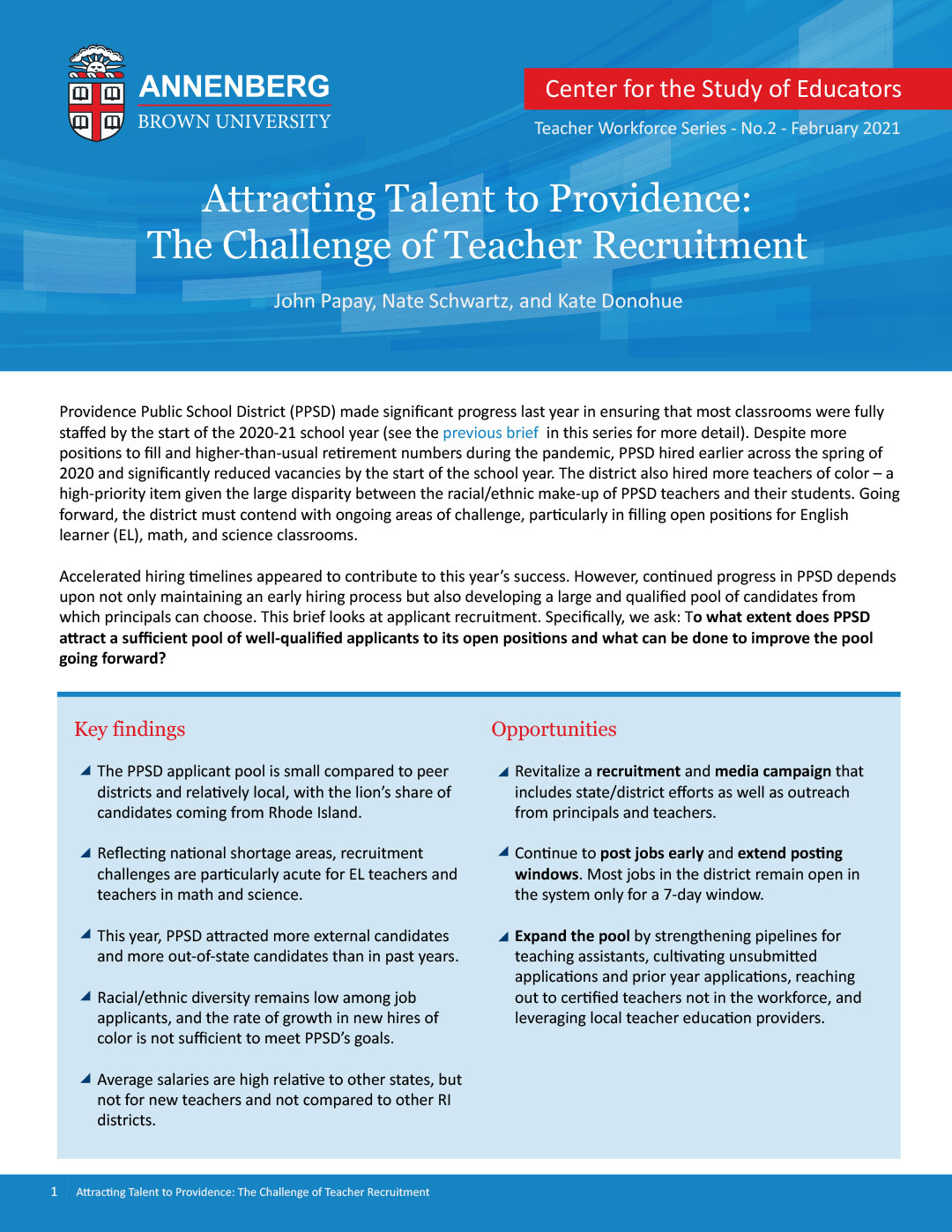
Attracting Talent to Providence: The Challenge of Teacher Recruitment

2021

Providence Public School District (PPSD) made significant progress last year in ensuring that most classrooms were fully staffed by the start of the 2020-21 school year (see the previous brief in this series for more detail). Despite more positions to fill and higher-than-usual retirement numbers during the pandemic, PPSD hired earlier across the spring of 2020 and significantly reduced vacancies by the start of the school year. The district also hired more teachers of color – a high-priority item given the large disparity between the racial/ethnic make-up of PPSD teachers and their students. Going forward, the district must contend with ongoing areas of challenge, particularly in filling open positions for English learner (EL), math, and science classrooms.

Accelerated hiring timelines appeared to contribute to this year’s success. However, continued progress in PPSD depends upon not only maintaining an early hiring process but also developing a large and qualified pool of candidates from which principals can choose. This brief looks at applicant recruitment. Specifically, we ask: To what extent does PPSD attract a sufficient pool of well-qualified applicants to its open positions and what can be done to improve the pool going forward?

Key findings

  • The PPSD applicant pool is small compared to peer districts and relatively local, with the lion’s share of candidates coming from Rhode Island.
  • Reflecting national shortage areas, recruitment challenges are particularly acute for EL teachers and teachers in math and science.
  • This year, PPSD attracted more external candidates and more out-of-state candidates than in past years.
  • Racial/ethnic diversity remains low among job applicants, and the rate of growth in new hires of color is not sufficient to meet PPSD’s goals.
  • Average salaries are high relative to other states, but not for new teachers and not compared to other RI districts.

Opportunities

  • Revitalize a recruitment and media campaign that includes state/district efforts as well as outreach from principals and teachers.
  • Continue to post jobs early and extend posting windows. Most jobs in the district remain open in the system only for a 7-day window.
  • Expand the pool by strengthening pipelines for teaching assistants, cultivating unsubmitted applications and prior year applications, reaching out to certified teachers not in the workforce, and leveraging local teacher education providers.

A Conversation About Teacher Recruitment in Providence

Discussing key challenges and opportunities faced by the Providence Public School District (PPSD) as it works to expand its teacher applicant pool and recruit teachers of color. We are convening a panel that includes a PPSD administrator, principal and community leader to talk about the policy implications of recent findings.

Suggested Citation:

Suggested citation

Center on the Study of Educators, Annenberg Institute at Brown University. (2021). Attracting talent to Providence: The challenge of teacher recruitment. https://annenberg.brown.edu/publications/attracting-talent-providence-challenge-teacher-recruitment

Share

◆
Publication Type

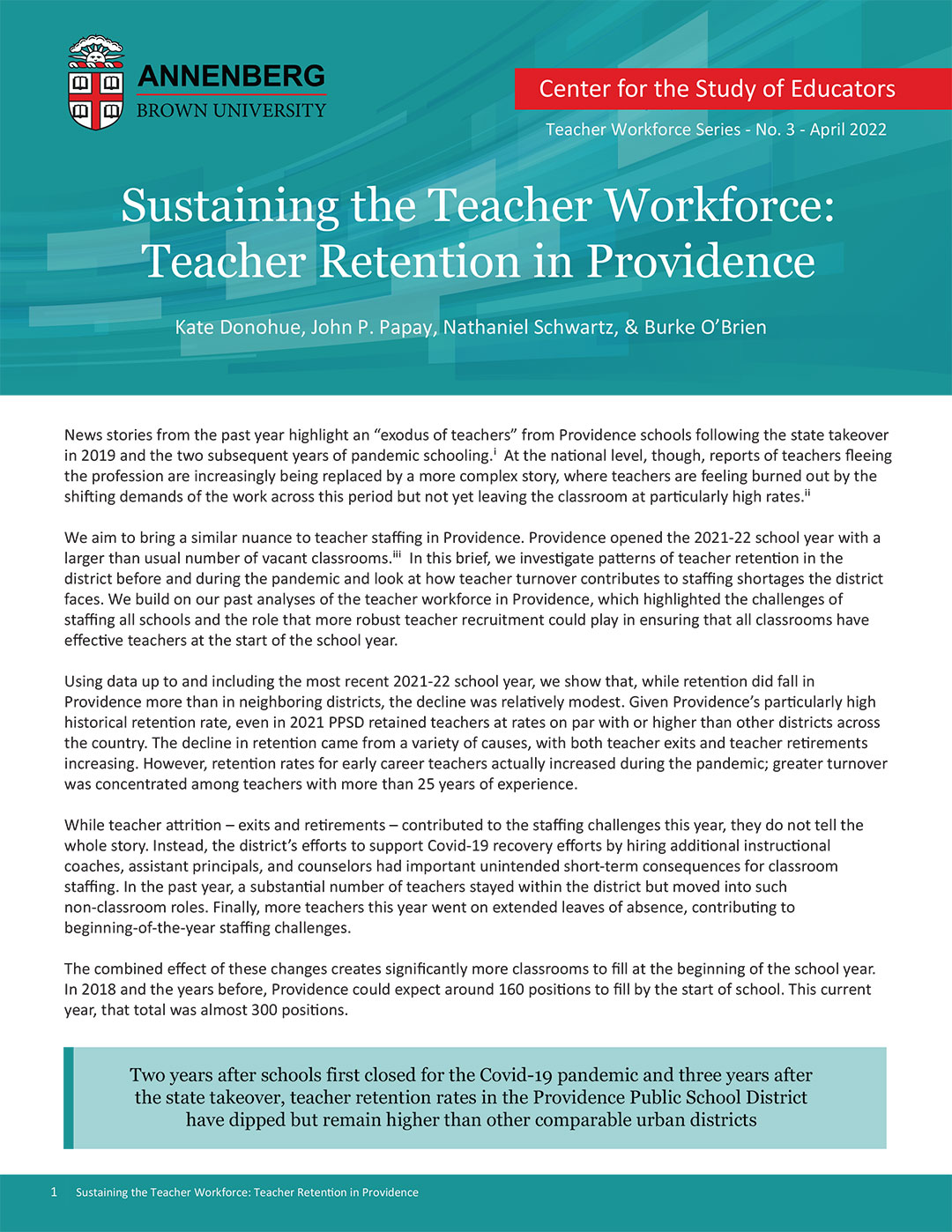
Sustaining the Teacher Workforce: Teacher Retention in Providence

2022

Two years after schools first closed for the Covid-19 pandemic and three years after the state takeover, teacher retention rates in the Providence Public School District have dipped but remain higher than other comparable urban districts.

News stories from the past year highlight an “exodus of teachers” from Providence schools following the state takeover in 2019 and the two subsequent years of pandemic schooling. At the national level, though, reports of teachers fleeing the profession are increasingly being replaced by a more complex story, where teachers are feeling burned out by the shifting demands of the work across this period but not yet leaving the classroom at particularly high rates.

We aim to bring a similar nuance to teacher staffing in Providence. Providence opened the 2021-22 school year with a larger than usual number of vacant classrooms. Like teachers across the country, teachers in Providence are facing substantial burdens produced by the pandemic and are teaching in a difficult political environment. In this brief, we investigate patterns of teacher retention in the district before and during the pandemic and look at how teacher turnover contributes to classroom staffing shortages the district faces. We build on our past analyses of the teacher workforce in Providence, which highlighted the challenges of staffing all schools and the role that more robust teacher recruitment could play in ensuring that all classrooms have effective teachers at the start of the school year.

Using data up and including the start of the 2021-22 school year, we show that, while retention did fall in Providence more than in neighboring districts, the decline was relatively modest. Given Providence’s high historical retention rate, even in 2021 PPSD retained teachers at rates on par with or higher than other districts across the country. The decline in retention came from a variety of causes, with both teacher exits and teacher retirements increasing. However, retention rates for early career teachers actually increased during the pandemic; greater turnover was concentrated among teachers with more than 25 years of experience.

While teacher attrition – exits and retirements – contributed to the classroom staffing challenges this year, they do not tell the whole story. Instead, the district’s efforts to support Covid-19 recovery efforts by hiring additional instructional coaches, assistant principals, and counselors had important unintended short-term consequences for classroom staffing. In the past year, a substantial number of teachers stayed within the district but moved into such non-classroom roles. Finally, more teachers this year went on extended leaves of absence, contributing to beginning-of-the-year staffing challenges.

The combined effect of these changes creates significantly more classrooms to fill at the beginning of the school year. In 2018 and the years before, Providence could expect around 160 positions to fill by the start of school. This current year, that total was almost 300 positions.

While these changes create issues with staffing, they also offer potential opportunities for the district. More teachers are moving into broader support positions, building a more substantial career ladder to retain high performing teachers. And, the ultimate impact of teacher turnover on students depends on who leaves and who stays. The data suggest that teachers who leave tend to have been replaced by a more diverse pool of new teachers, allowing the district to make progress in diversifying its workforce. Going forward, the district can redouble efforts to retain its most effective teachers by creating work environments where teachers can thrive. It can also be sure to effectively take advantage of the opportunities presented to hire new teachers as more teachers will be retiring over the next several years.

Suggested Citation:

Suggested citation

Center on the Study of Educators, Annenberg Institute at Brown University. (2022). Sustaining the teacher workforce: Teacher retention in Providence. https://annenberg.brown.edu/publications/sustaining-teacher-workforce-teacher-retention-providence

Share

◆
Publication Type

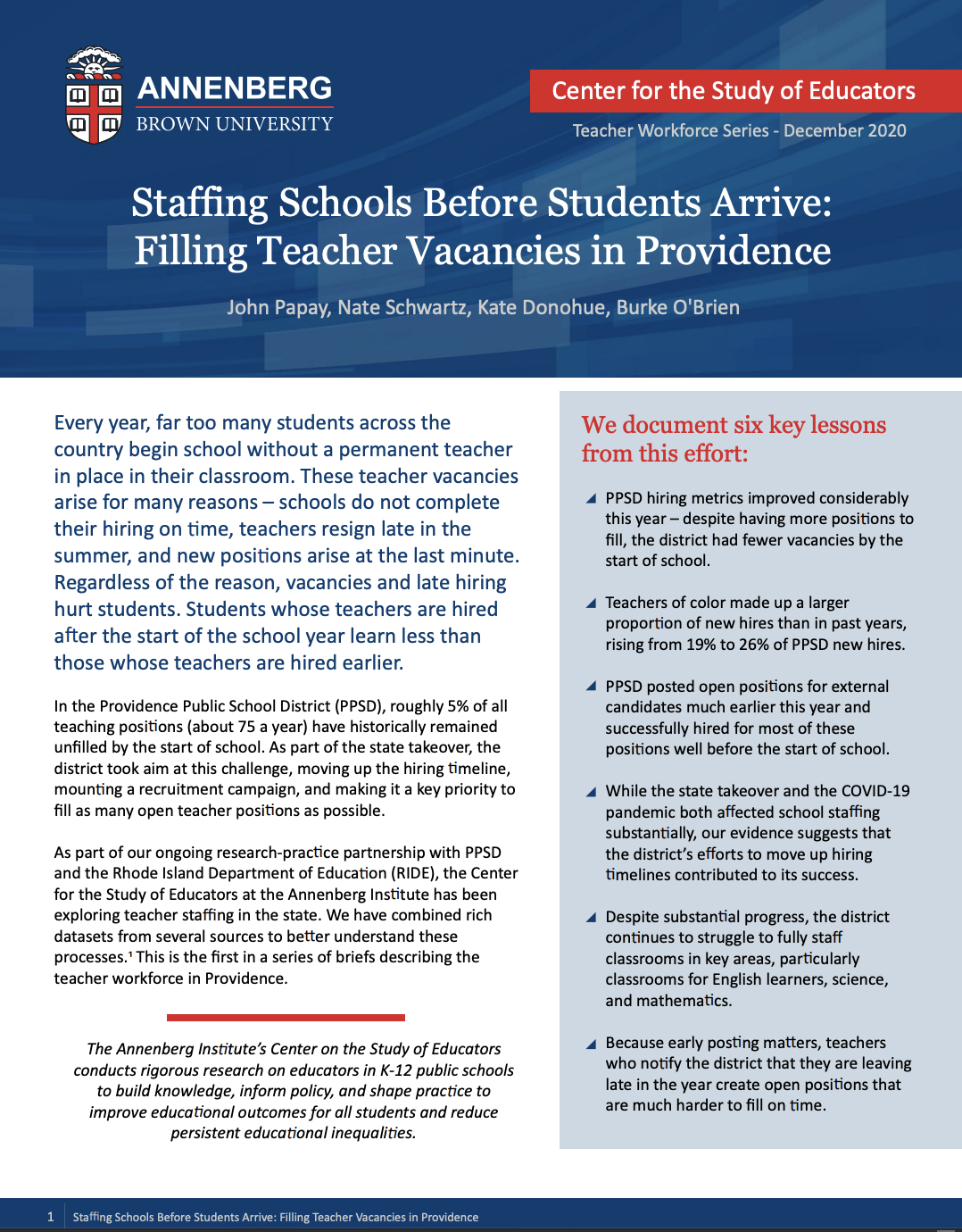
Staffing Schools Before Students Arrive: Filling Teacher Vacancies in Providence

2020
staffing schools before students arrive

Every year, far too many students across the country begin school without a permanent teacher in place in their classroom. These teacher vacancies arise for many reasons – schools do not complete their hiring on time, teachers resign late in the summer, and new positions arise at the last minute. Regardless of the reason, vacancies and late hiring hurt students. Students whose teachers are hired after the start of the school year learn less than those whose teachers are hired earlier.

In the Providence Public School District (PPSD), roughly 5 percent of all teaching positions (about 100 a year) have historically remained unfilled by the start of school. As part of the state takeover, the district took aim at this challenge, moving up the hiring timeline, mounting a recruitment campaign, and making it a key priority to fill as many open teacher positions as possible.

As part of our ongoing research-practice partnership with PPSD and the Rhode Island Department of Education (RIDE), the Center for the Study of Educators at the Annenberg Institute has been exploring teacher staffing in the state. We have combined rich datasets from several sources to better understand these processes. This is the first in a series of briefs describing the teacher workforce in Providence.


We document six key lessons from this effort:

  • PPSD hiring metrics improved considerably this year – despite having more positions to fill, the district had fewer vacancies by the start of school.
  • Teachers of color made up a larger proportion of new hires than in past years, rising from 19% to 26% of PPSD new hires.
  • PPSD posted open positions for external candidates much earlier this year and successfully hired for most of these positions well before the start of school.
  • While the state takeover and the COVID-19 pandemic both affected school staffing substantially, our evidence suggests that the district’s efforts to move up hiring timelines contributed to its success.
  • Despite substantial progress, the district continues to struggle to fully staff classrooms in key areas, particularly classrooms for English learners, science, and mathematics.
  • Because early posting matters, teachers who notify the district that they are leaving late in the year create open positions that are much harder to fill on time.

Suggested Citation:

Suggested citation

Center on the Study of Educators, Annenberg Institute at Brown University. (2020). Staffing schools before students arrive: Filling teacher vacancies in Providence. https://annenberg.brown.edu/publications/staffing-schools-students-arrive-filling-teacher-vacancies-providence

Share

◆
Publication Type

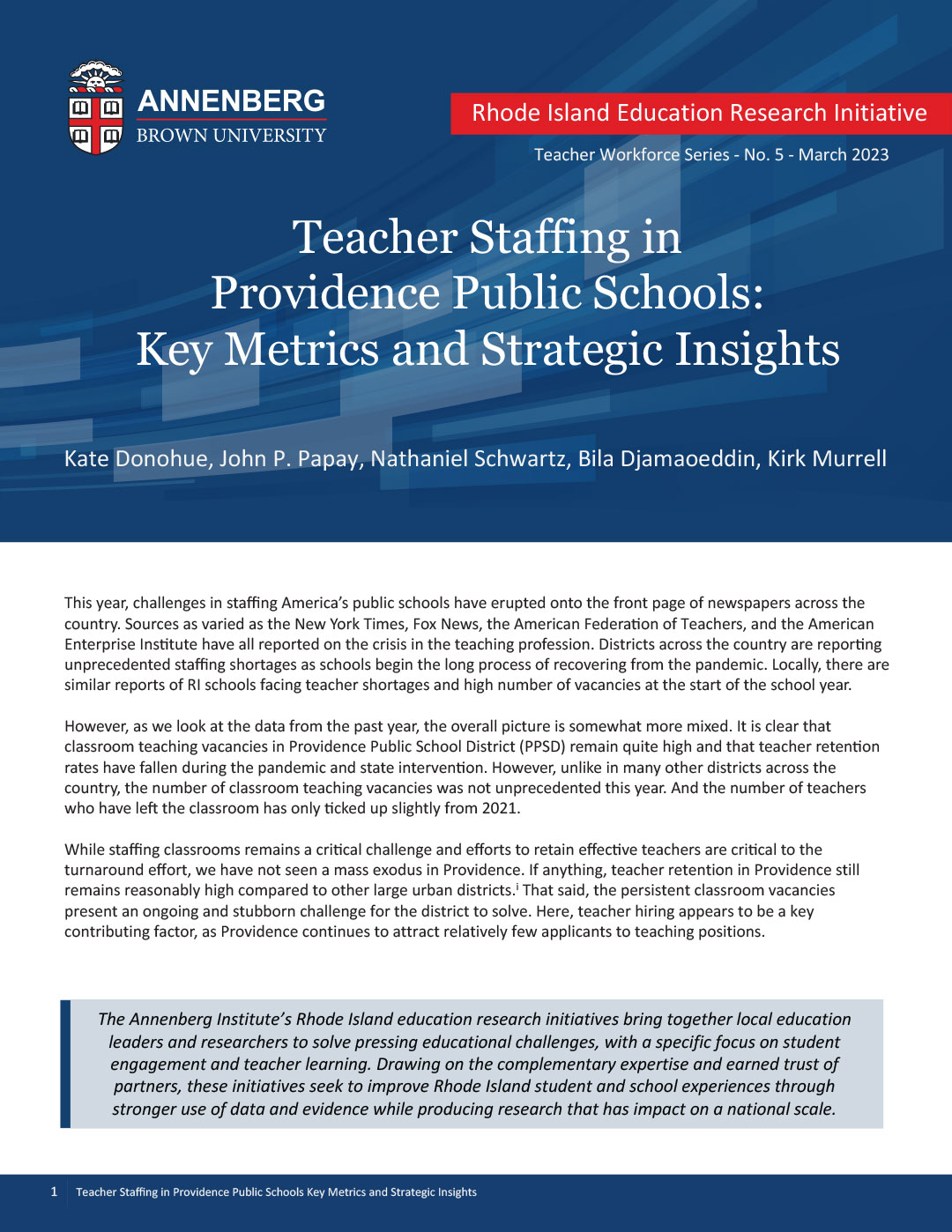
Teacher Staffing in Providence Public Schools: Key Metrics and Strategic Insights

2023

This year, challenges in staffing America’s public schools have erupted onto the front page of newspapers across the country. Sources as varied as the New York Times, Fox News, the American Federation of Teachers, and the American Enterprise Institute have all reported on the crisis in the teaching profession. Districts across the country are reporting unprecedented staffing shortages as schools begin the long process of recovering from the pandemic. Locally, there are similar reports of RI schools facing teacher shortages and high number of vacancies at the start of the school year.

However, as we look at the data from the past year, the overall picture is somewhat more mixed. It is clear that classroom teaching vacancies in Providence Public School District (PPSD) remain quite high and that teacher retention rates have fallen during the pandemic and state intervention. However, unlike in many other districts across the country, the number of classroom teaching vacancies was not unprecedented this year. And the number of teachers who have left the classroom has only ticked up slightly from 2021.

While staffing classrooms remains a critical challenge and efforts to retain effective teachers are critical to the turnaround effort, we have not seen a mass exodus in Providence. If anything, teacher retention in Providence still remains reasonably high compared to other large urban districts. That said, the persistent classroom vacancies present an ongoing and stubborn challenge for the district to solve. Here, teacher hiring appears to be a key contributing factor, as Providence continues to attract relatively few applicants to teaching positions.

Suggested Citation:

Suggested citation

Annenberg Institute at Brown University. (n.d.). Teacher staffing in Providence Public Schools: Key metrics and strategic insights. https://annenberg.brown.edu/publications/teacher-staffing-providence-public-schools-key-metrics-and-strategic-insights

Share

◆
Publication Type

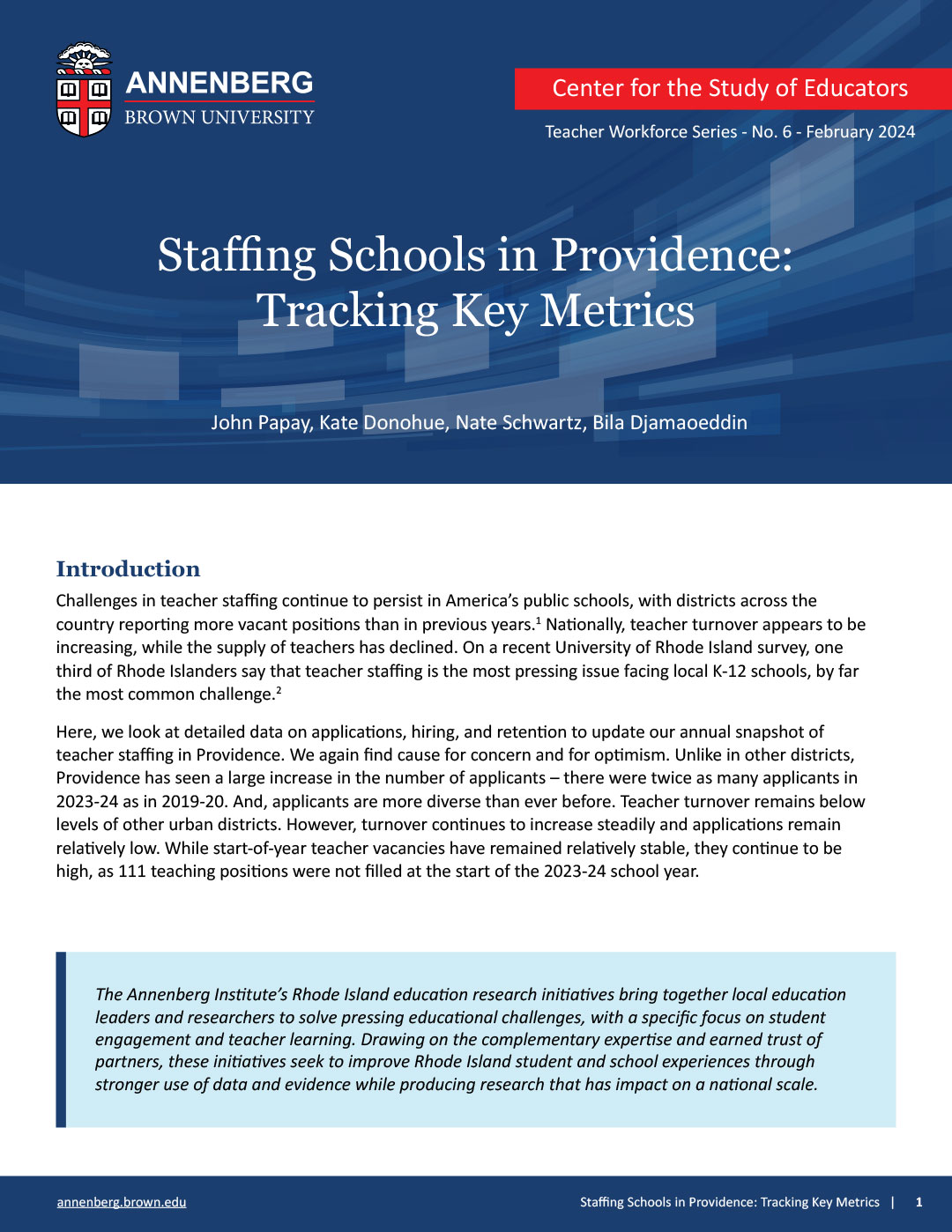
Staffing Schools in Providence: Tracking Key Metrics

2024

Teacher staffing is a growing challenge in PPSD in the wake of the pandemic. In order to ensure that every classroom is filled with an effective teacher, the district will need to continue to strengthen both recruitment and retention efforts. In this brief, we highlight data-driven opportunities that build on existing strategies, particularly around recruitment practices, and have identified where targeted retention efforts could be most beneficial.

This brief highlights six key data-drive opportunities:

  1. Retention rates are particularly low for novice and early career teachers. The district should strengthen retention efforts for these groups, and particularly new hires.
  2. The application pool remains relatively thin. Expanding partnerships and recruitment efforts with local educator preparation programs (EPPs), particularly in hard-to-staff subject areas, is a promising approach.
  3. More than half of teachers in the applicant pool have at least 3 years of teaching experience, providing opportunities to cultivate these candidates and hire more experienced teachers.
  4. PPSD’s marketing campaign drew interest but few applicants, suggesting opportunities to engage with applicants throughout the application process.
  5. New hires who have worked in PPSD are more diverse and have higher retention rates, pointing to the importance of continuing to build prospective teacher pipelines for existing PPSD staff.
  6. Vacancies are overwhelmingly in hard-to-staff subject areas and are exacerbated by late resignations. The district could expand early contracts in anticipation of these challenges.

As PPSD and districts across the state are facing funding shortages driven by enrollment declines and the end of stimulus dollars, it is more important than ever to ensure that limited resources are being leveraged in the highest impact ways. The district (and the state as a whole) needs to continue to invest in ensuring that classrooms are staffed with educators who can support the learning and development of all students. This means using scarce resources to recruit and retain a highly effective and increasingly diverse workforce and creating the conditions in schools that allow all teachers to succeed.

Suggested Citation:

Suggested citation

Center on the Study of Educators, Annenberg Institute at Brown University. (n.d.). Staffing schools in Providence: Tracking key metrics. https://annenberg.brown.edu/publications/staffing-schools-providence-tracking-key-metrics

Share