
Publication Type

Unequal Returns: Intragenerational Asset Accumulation Differs by Net Worth in Early Adulthood

2018

We use quantile regression models of Panel Study of Income Dynamics (PSID) data to assess whether initial net worth moderates the relationship between initial economic standing (net worth and income) and later net worth (measured in 2011). Conditional quantile regression results suggest the returns to an increase in 1989 net worth or income vary substantially between the 25th, 50th, and 75th percentiles of 1989 net worth, with higher returns among those with higher initial net worth. Thus, financial improvement appears to generate different outcomes depending on initial net worth. These results suggest that helping families build an asset foundation may increase the efficacy of interventions that increase family income.

Suggested Citation:

Suggested citation

Elliott, William, Emily Rauscher, and Ilsung Nam. (2018). Unequal Returns: Intragenerational Asset Accumulation Differs by Net Worth in Early Adulthood. Children and Youth Services Review. https://doi.org/10.1016/j.childyouth.2018.01.006
Share

Publication Type

We're Not Rich, But We're Definitely Not Poor: Young Children's Conceptions of Social Class

2017

Relative deprivation theory suggests that perceived socioeconomic standing has implications for multiple aspects of life. Early childhood is critical for later development and concern about effects of rising inequality on children has grown along with inequality in recent decades. However, one of the key requirements for relative deprivation to matter for child outcomes is that children must have a sense of social class and their socioeconomic standing. Because the voices of children are often lost among current debates, this paper poses two questions: 1) How do young children conceive of social class and their standing in the distribution in the context of high inequality; and 2) How do these conceptions develop over time? We conducted longitudinal, semi-structured interviews with 44 young children (ages 5–6), who attend the same three elementary schools in a small Midwestern city. By following the same children over two years, this study is uniquely able to shed light on how conceptions of class develop over time. We found that, as children got older, they increasingly associated money with differences in quality, became more likely to assign value judgements to money, and became less reliant on verbal proof of wealth. Although many children misreport their own socioeconomic standing, our findings suggest young children are aware of social class inequality and may therefore experience relative deprivation. Reducing inequality could mitigate potential implications of relative deprivation for child development.

Suggested Citation:

Suggested citation

Rauscher, Emily, Terri Friedline, and Mahasweta Banerjee. (2017). We're Not Rich, But We're Definitely Not Poor: Young Children's Conceptions of Social Class. Children and Youth Services Review. https://doi.org/10.1016/j.childyouth.2017.10.035

Share

Publication Type

The Socialization Areas in Which European American and Chinese Immigrant Mothers Express Warmth and Control

2018

Objective. The present study examined specific situations in which European American and Chinese immigrant mothers to the United States expressed warmth and control with their young children. Design. Ninety-four European American and 90 Chinese immigrant mothers of children ages 3–6 from middle-class families were interviewed. Results. European American and Chinese immigrant mothers viewed children’s independence, educational, social, emotional, and moral development as important. Specifically, mothers from both cultural groups discussed expressing warmth toward their children when: (1) structuring their children’s daily schedules and routines, (2) doing activities with their children, (3) their children experience difficulties, (4) being close, showing intimacy and communicating with their children, (5) their children engage in positive behaviors, and (6) educating their children. Mothers also similarly discussed utilizing control when: (1) structuring their children’s daily schedules and routines, (2) ensuring their child’s safety, (3) their children engage in difficult behaviors, (4) their children interact with others, (5) educating their children, and (6) their children experience moral-related issues. However, mothers differentially endorsed four out of six situations of when they expressed warmth and four out of six situations of when they exerted control. Specifically, European American mothers emphasized expressing warmth and control about Western cultural values of individuality, open-expression, and respect. In contrast, Chinese immigrant mothers emphasized expressing warmth and control about psychological interdependence and Confucian-based values of group harmony and child obedience. Conclusions. This study highlights culturally shared and distinct socialization priorities that European American and Chinese immigrant mothers emphasize during early childhood.

Suggested Citation:

Suggested citation

Vu, K. T. T. Cheah, C. S. L., Zhou, N., Leung, C. Y. Y., Li, J., & Yamamoto, Y. (2018). The Socialization Areas in Which European American and Chinese Immigrant Mothers Express Warmth and Control. Parenting: Science and Practice. https://doi.org/10.1080/15295192.2018.1524244

Share

Publication Type

How European American and Taiwanese mothers talk to their children about learning

2013

Little cross‐cultural research exists on parental socialization of children's learning beliefs. The current study compared 218 conversations between European American and Taiwanese mothers and children (6–10 years) about good and poor learning. The findings support well‐documented cultural differences in learning beliefs. European Americans mentioned mental activities and positive affect more, whereas Taiwanese mentioned learning virtues and negative affect more. Mothers, especially European American, reciprocated their children's talk about mental activities, learning virtues, and negative affect. Children, especially Taiwanese, reciprocated their mother's talk about positive affect. Mothers invoked more mental activities and positive affect when discussing good learning, but more learning virtues and negative affect when discussing poor learning. These findings reveal a source of cultural differences in beliefs and potential enculturation.

Suggested Citation:

Suggested citation

Li, J., Fung, H., Bakeman, R., Rae, K., & Wei, W.C. (2013). How European American and Taiwanese mothers talk to their children about learning. Child Development. https://doi.org/10.1111/cdev.12172

Share

Publication Type

Hidden Gains: Effects of Early U.S. Compulsory Schooling Laws on Attendance and Attainment by Social Background

2014

Research on early compulsory schooling laws finds minimal effects on attendance but fails to investigate heterogeneous effects. Similarly, research proposes limited contexts in which expansion policies can increase equality but has difficulty separating policy and cohort effects. Capitalizing on within-country variation in timing of early compulsory laws, passed 1852 to 1918, I ask whether they improved equality of school attendance or educational attainment by class, nativity, and race. Based on census data, compulsory laws increased equality of attendance and attainment, particularly among young men in the North, where the laws reduced class and race gaps by over 20%. Early compulsory schooling laws provided “hidden gains,” missed in previous analyses, suggesting policies that raise minimum schooling can increase educational equality in certain contexts.

Suggested Citation:

Suggested citation

Rauscher, Emily. (2014). Hidden Gains: Effects of Early U.S. Compulsory Schooling Laws on Attendance and Attainment by Social Background. Educational Evaluation and Policy Analysis.

Share

Publication Type

School Differences in Social–Emotional Learning Gains: Findings From the First Large-Scale Panel Survey of Students

2019

Measures of school-level growth in student outcomes are common tools for assessing the impacts of schools. The vast majority of these measures use standardized tests as the outcome of interest, even though emerging evidence demonstrates the importance of social–emotional learning (SEL). In this article, we present results from using the first large-scale panel surveys of students on SEL to produce school-level value-added measures by grade for growth mind-set, self-efficacy, self-management, and social awareness. We found substantive differences across schools in SEL growth, with magnitudes of differences similar to those for growth in academic achievement. In contrast, we found that the goodness of fit of the value-added model was considerably lower when the outcome variables were measures of SEL constructs rather than of academic achievement. In addition, the across-school variance in the average level of the SEL measures was proportionally much smaller than that for academic measures. These findings recommend caution in interpreting measures as the causal impacts of schools on SEL, though they also do not rule out important school effects.

Suggested Citation:

Suggested citation

Christian, M., Hough, H.J., Loeb, S., Meyer, R., Rice, A., & West, M. (2019). School Differences in Social–Emotional Learning Gains: Findings From the First Large-Scale Panel Survey of Students. Journal of Educational and Behavioral Statistics. https://doi.org/10.3102/1076998619845162

Share

Publication Type

Differing Views of Equity: How Prospective Educators Perceive Their Role in Closing Achievement Gaps

Hiring is an opportunity for school districts to find educators with values and beliefs that align with district goals. Yet beliefs are difficult to measure. We use administrative data from more than ten thousand applications to certificated positions in an urban California school district in which applicants submitted essays about closing achievement gaps. Using structural topic modeling (STM) to code these essays, we examine whether applicants systematically differ in their use of these themes and whether themes predict hiring outcomes. Relative to white applicants, Hispanic and African American applicants are more likely to identify structural causes of inequities and discuss educators’ responsibilities for addressing inequality. Similar differences in themes emerge between applicants to schools with different student populations. Techniques like STM can decipher hard-to-measure beliefs from administrative data, providing valuable information for hiring and decision making.

Suggested Citation:

Suggested citation

Penner, E., Rochmes, J., Liu, J., Solanki, S., & Loeb, S. (2019). Differing Views of Equity: How Prospective Educators Perceive Their Role in Closing Achievement Gaps. RSF: The Russell Sage Foundation Journal of the Social Sciences. https://doi.org/10.7758/RSF.2019.5.3.06

Share

Measuring School Contributions to Growth in Social-Emotional Learning

2019

Executive Summary:

School value-added models are increasingly used to measure schools’ contributions to student success. At the same time, policymakers and researchers agree that schools should support students’ social-emotional learning (SEL) as well as academic development. Yet, the evidence regarding whether schools can influence SEL and whether statistical growth models can appropriately measure this influence is limited.
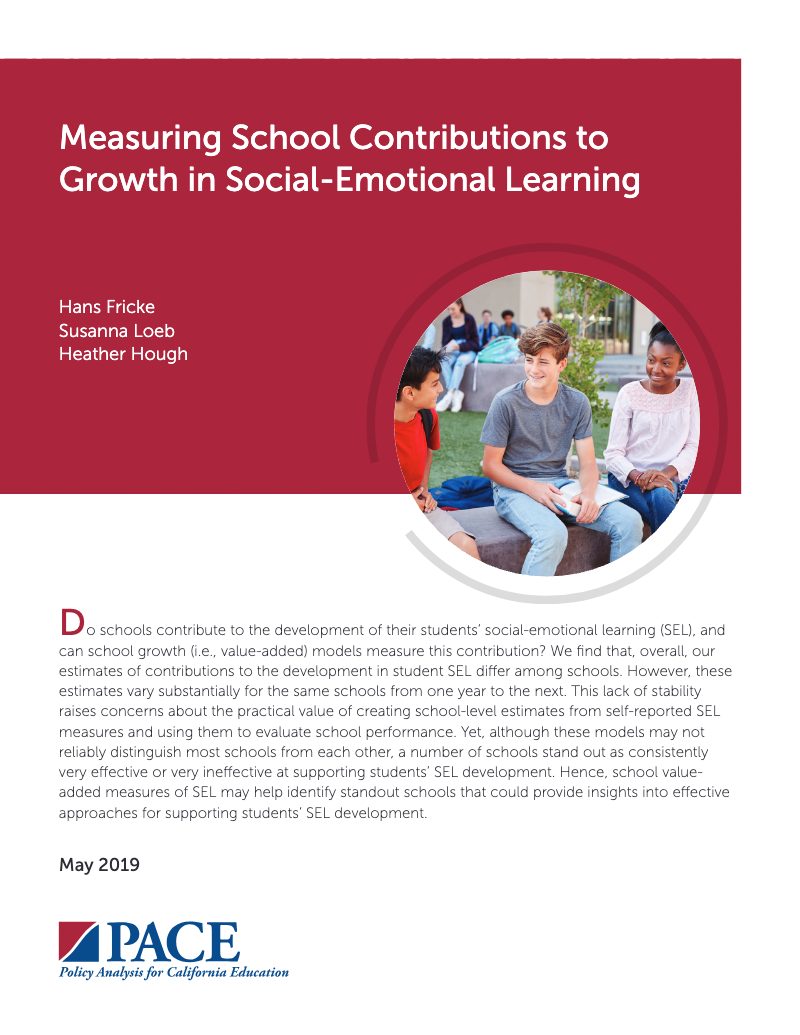
Cover of Measuring School Contributions to Growth in Social-Emotional Learning
School value-added models are increasingly used to measure schools’ contributions to student success. At the same time, policymakers and researchers agree that schools should support students’ social-emotional learning (SEL) as well as academic development. Yet, the evidence regarding whether schools can influence SEL and whether statistical growth models can appropriately measure this influence is limited. Recent work shows meaningful differences across schools in changes in SEL scores by grade, but whether these differences represent the effects of schools is still unclear. The current paper builds upon this earlier work by examining the stability of the estimated school-by-grade effects on SEL across two years, using a large-scale SEL survey administered in California’s CORE districts. We find that correlations among school effects in the same grades across different years are positive, but they are lower than those for math and English Language Arts (ELA). Schools in the top or the bottom of the school effect distribution are more persistent in their impacts across years than those in the middle of the distribution. Overall, the results provide evidence that these school effects measure real contributions to SEL. However, the low stability of effects from one year to the next draw into question whether including these school value-added measures of self-reported SEL in school performance frameworks and systems would be beneficial.

Suggested Citation:

Suggested citation
Fricke, H., Loeb, S., & Hough, H.

Share

Publication Type

‘They Will Go Like I Did’: How Parents Think about College for Their Young Children in the Context of Rising Costs

2017

Rising college costs and student loan burdens have triggered national debates about whether a college degree is “worth it.” Parents raising children in the midst of these debates may be evaluating the value of a college degree relative to its costs and adjusting their educational expectations for their children, shaping future generations' socialization toward college. In this context, it is unclear how theoretical models on college attendance decision-making perform in explaining parents' thoughts about college for their children. This qualitative study elicited early perspectives on college through in-depth interviews with 37 parents of kindergarten children from one school district in a mid-sized, Midwestern city. Almost unanimously, lower-income parents with some college education saw a college degree as a catalyst of their children's upward mobility, though very few thought they could help their children afford college. Higher-income parents more often expressed doubts about pursuing a college degree or the value of that degree acquired with debt.

Suggested Citation:

Suggested citation

Friedline, Terri, Emily Rauscher, Stacia West, Barbara Phipps, Nadzeya Kardash, Karin Chang, and Meghan Ecker-Lyster. (2017). ‘They Will Go Like I Did’: How Parents Think about College for Their Young Children in the Context of Rising Costs. Children and Youth Services Review. https://doi.org/10.1016/j.childyouth.2017.08.027

Share

Publication Type

Plastic and Immobile: Unequal Intergenerational Transmission by Genotype within Sibling Pairs

2017

Contrary to traditional biological arguments, the differential susceptibility model suggests genotype may moderate rather than mediate parent-child economic similarity. Using family fixed effects models of Add Health sibling data, I investigate the relationship between an index of sensitive genotypes and intergenerational mobility. Full, same sex sibling comparisons hold constant parental characteristics and address the non-random distribution of genotype that reduces internal validity in nationally representative samples. Across multiple measures of young adult financial standing, those with more copies of sensitive genotypes achieve lower economic outcomes than their sibling if they are from a low income context but fare better from a high income context. This genetic sensitivity to parental income entails lower intergenerational mobility. Results support the differential susceptibility model and contradict simplistic genetic explanations for intergenerational inequality, suggesting sensitive genotypes are not inherently positive or negative but rather increase dependence on parental income and reduce mobility.

Suggested Citation:

Suggested citation

Rauscher, Emily. (2017). Plastic and Immobile: Unequal Intergenerational Transmission by Genotype within Sibling Pairs. Social Science Research. https://doi.org/10.1016/j.ssresearch.2017.02.005

Share