Presents the National Research Council's framework for evaluating advanced-level teacher certification programs and its evaluation of the National Board for Professional Teaching Standards.
Uses data on every New York State elementary teacher from 1994 to 2002 to examine how fourth grade state testing affected teacher turnover and recruitment.
Analyzes attrition among New York City elementary and middle school teachers and whether those who transfer or leave are more or less effective than those who stay.
Investigates the multiple pathways into teaching in New York City as a microcosm of a national experiment in recruiting, preparing, and retaining teachers.
Examines how teaching conditions predict teacher turnover in California schools, especially those serving low-income, low-achieving, and minority students.
Finds that teachers' mathematical knowledge for teaching is significantly related to first and third graders' mathematics achievement gains over a school year.
Evaluates whether California's Mathematics Professional Development Institutes improved teachers' mathematical knowledge for teaching, using new content knowledge measures.
Documents striking differences in teacher qualifications across New York State schools and how attrition, transfers, and initial job matches shape them.
In Brown Alumni Magazine, President Christina Paxson traces the Annenberg Institute's history from Walter Annenberg's $500 million challenge to its new focus.
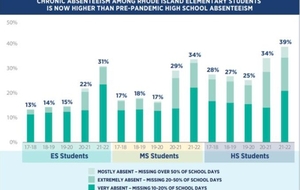
WPRI reports that Rhode Island students are missing school at record-high levels, sometimes for months, as chronic absenteeism persists after the pandemic.
A RISSA–Annenberg workshop for district and school leaders on what high-quality social and emotional development looks like across tiers in secondary schools.
Results for America and the Annenberg Institute release four EdResearch for Recovery briefs on supporting students during and after the COVID-19 pandemic.