The Boston Globe reports on Providence's bid to change teacher seniority rules, citing a Center for the Study of Educators report on the district's applicant pool.
Reuters covers the layoffs of hundreds of thousands of school employees, with Susanna Loeb on which staff districts cut first and the lasting harm to students.
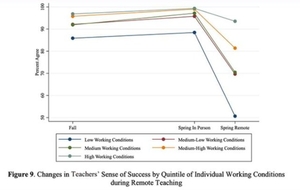
FutureEd covers research by Matthew Kraft, Nicole Simon, and Melissa Arnold Lyon on how teacher working conditions sustained teachers' sense of success during remote learning.
NBC News covers the rise of private tutoring amid school uncertainty, citing projections that students will return having retained only a fraction of a typical year's gains.
Phys.org covers research showing text-message nudges from school counselors raise financial aid completion by 17 percent and college enrollment by 8 percent.
New research in Educational Evaluation and Policy Analysis by Kathleen Lynch, Heather Hill, and colleagues identifies what works in STEM teacher professional development.
The Journal of Human Resources highlights a preprint by Jing Liu and Susanna Loeb on how teachers who value attendance raise students' odds of finishing high school.
Brown's Department of Education welcomes Christopher Cleveland, whose research-practice partnerships focus on the experiences of students with disabilities, as Assistant Professor.
In The 74, Sarah Johnson argues teacher professional development is in a rut and points to the Research Partnership for Professional Learning as a way forward.
Education Week reports on a working paper finding that teacher strikes more than double the likelihood that congressional candidates run education ads.
WBUR examines how educators and students are finding a new normal, with research pointing to tutoring and individualized support for addressing learning loss.
News from Brown announces the Library's new Center for Library Exploration and Research, which complements community-focused work by the Annenberg Institute and others.
The 74 reports on a survey finding more than half of teachers felt less successful after the shift to remote learning, with working conditions a key factor.
Education Week's How We Go Back to School series examines how districts can measure and address the achievement setbacks caused by disrupted schooling.
The National Council on Teacher Quality discusses how to measure teachers' contributions to students beyond test scores, drawing on Annenberg-affiliated research.
Highlights from the #gotequityRI Educational Equity and Teacher Diversity Policy Forum, hosted with the Equity Institute, Latino Policy Institute, and PLEE.
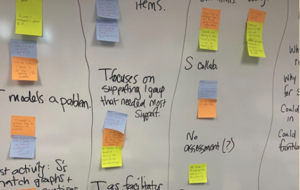
The PL Network's third Deep Dive at Mount Hope High School in Bristol-Warren, focused on how department chairs and instructional rounds drive curriculum implementation in 9th and 10th grade math.