A difference-in-differences study finding that heightened federal immigration enforcement after January 2025 raised daily absence rates among foreign-born students by roughly a third, with effects largest in upper grades.
Contradictory evidence of the relationship between education funding and student achievement could reflect heterogeneous effects by revenue source or student characteristics. This study examines potential heterogeneous effects of a particular type of local revenue—bond funds for capital investments—on achievement by socioeconomic status.
Meta-analyzes 95 experimental and quasi-experimental preK-12 STEM professional development and curriculum programs to identify features linked to stronger student outcomes.
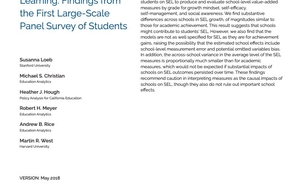
Uses the first large-scale panel surveys of social-emotional learning to produce school-level value-added measures for growth mindset, self-efficacy, self-management, and social awareness.
Investigates whether young children have a sense of social class and their own socioeconomic standing, a prerequisite for relative deprivation to shape child outcomes.
Shows, using data from California's CORE districts, that surveys of social-emotional learning and school climate are reliable, valid, and informative measures of school performance.
Uses a nationally representative kindergarten cohort to examine how ADHD severity shapes the relationship between diagnosis and later academic achievement.
Studies how school organizational contexts relate to teacher turnover and student achievement in New York City middle schools using school survey data.
Examines whether boys' early behavior problems predict their lower rates of high school graduation, college completion, and years of schooling in adulthood.
Surveys 1,368 eighth graders on non-cognitive skills, finding that scales predict individual outcomes but behave paradoxically at the school level and in charter comparisons.
Richard Welsh will discuss research on inequities in school discipline, exploring the causes of disciplinary disparities and approaches for creating more equitable policies and practices in K–12 education.
This talk will examine how state-level child care subsidies shape maternal time use, exploring the relationship between early care policies, family resources, and parent-child interactions.